Can AI write a good workout plan? What the research found
Researchers have asked chatbots to write training plans and had experts grade them. The plans look professional. The problems hide in progression, personalization and medical cautions.
The short version
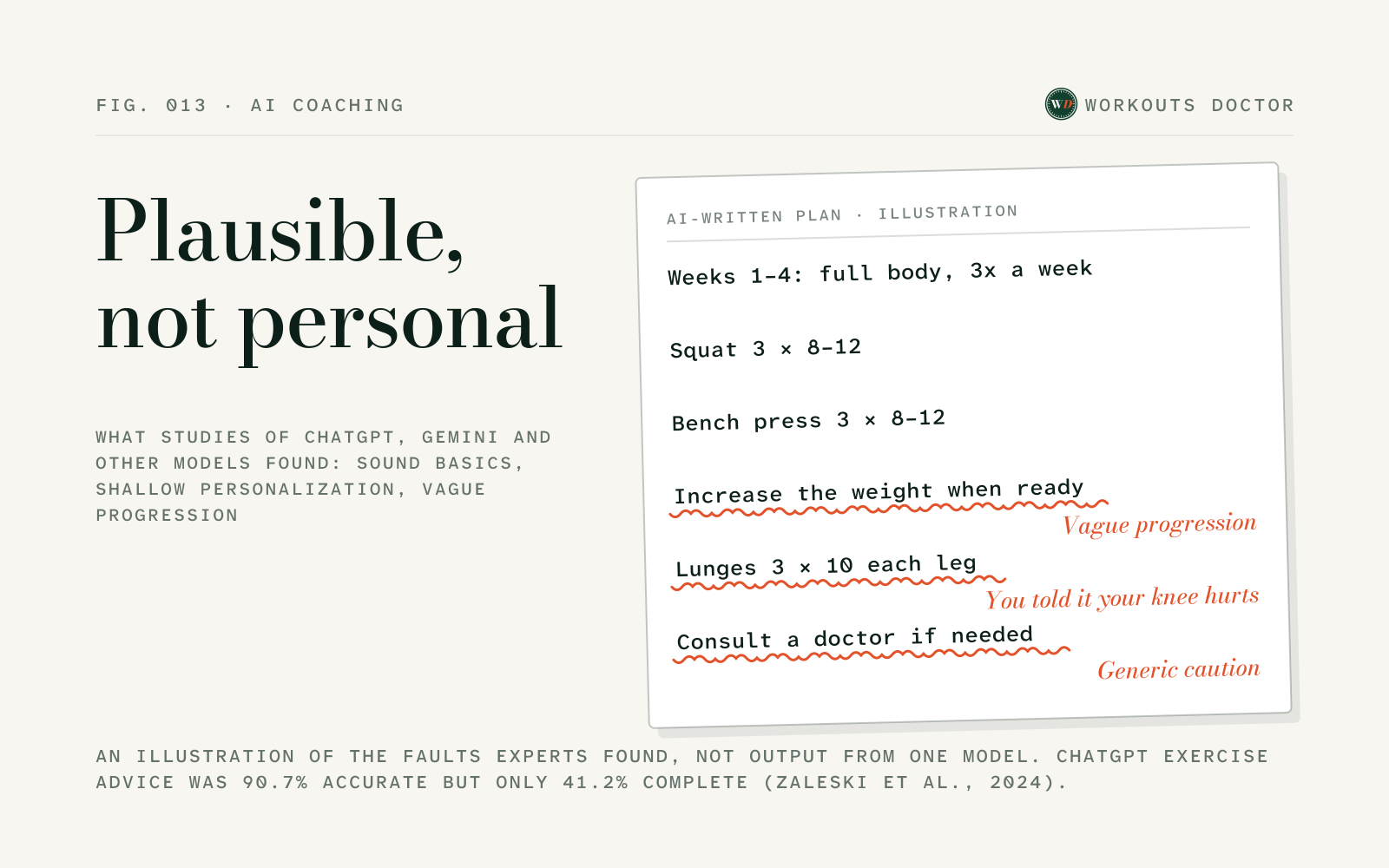
- Across 26 clinical populations, ChatGPT's exercise advice was 90.7% accurate but contained only 41.2% of the recommendation elements experts looked for.
- GPT-4 wrote broadly safe 30-day programs for five people with health conditions, but experts found them imprecise and often too cautious to work well.
- Detailed prompts produced higher-rated plans in two expert-panel studies, and more consistent plans in the second.
- No study we found tested whether people who followed an AI-written plan got stronger, fitter or stayed injury-free.
- Dedicated coaching apps work from your training log and fixed planning rules rather than a single chat; Budy is our top example (we make it).
AI can write a decent first draft of a workout plan, not a finished one. When researchers had experts grade plans from ChatGPT, Copilot, Gemini and other chatbots, the plans were broadly safe and improved with detailed prompts. They were also generic, vague about progression and sometimes wrong about medical cautions. No study we found tested whether people who followed them got fitter.
What did the studies actually test?
The studies below all worked the same way. Researchers describe a hypothetical person to a large language model, the kind of AI behind ChatGPT, Claude and Gemini, and experts grade the plan it writes. Nobody followed the plans, so the studies measure quality on paper, not results.
| Study | Models and date | What was graded | Main finding |
|---|---|---|---|
| Zaleski et al., 2024 | ChatGPT, March 2023 | Exercise advice for 26 clinical populations, scored in 10 categories | 90.7% accurate, 41.2% complete; most errors about medical clearance |
| Dergaa et al., 2024 | GPT-4, June 2023 | 30-day programs for five people with health conditions | Broadly safe, but imprecise and often too cautious |
| Washif et al., 2024 | GPT-3.5 and GPT-4 | 12-week resistance-training programs for intermediate and advanced 20-year-olds | Useful drafts that need fine-tuning; similar plans for men and women |
| Havers et al., 2025 | GPT-4 via Copilot and Gemini 1.0 Pro, February 2024 | Eight muscle-building plans rated by 12 coaches | Same quality on repeat; better with detailed prompts; GPT-4 rated higher |
| Yang et al., 2026 | GPT-4 via ChatGPT | Eight programs from simple or detailed prompts, rated by 11 experts | Detail raised ratings and cut variation; repeats still differed |
| Montaruli et al., 2026 | Eight versions of Claude, ChatGPT, Gemini and DeepSeek | Six-month marathon plans for three levels | Core principles mostly right; some skipped weekly mileage or merged levels |
The models tested have since been replaced by newer versions. Read the findings as a map of typical weak spots, not a ranking of today’s products.
What do AI workout plans get right?
The broad strokes. AI plans tend to be cautious, well organized and close to textbook guidance, and they get better when you give them detail.
- Safe defaults. GPT-4 wrote broadly safety-conscious programs for all five of Dergaa’s hypothetical patients, who had high blood pressure, osteoarthritis, anxiety, type 2 diabetes or asthma.
- Sensible structure. In Washif’s study, ChatGPT split 12-week programs into three 4-week phases with different aims, and GPT-4 adjusted its plans for intermediate versus advanced lifters.
- Core principles. Most chatbots in the marathon study included progressive weekly mileage, a taper and an intensity split with more than 80% of training at low intensity.
- Repeatable quality. When Havers’ team entered the same prompts again, coaches’ ratings of the resulting plans did not differ on 27 of 28 quality items.
- Detail pays. Plans from detailed prompts scored higher in both the Havers and Yang studies. In Yang’s study, detail improved ratings for personalization, safety and feasibility, though not for effectiveness, and made repeat outputs more stable.
Where do AI workout plans fall short?
In the parts that make a plan yours: how it progresses, how well it fits your body and history, and what it says about medical risk. And an AI plan reads with the same confidence whether it is right or wrong.
Progression is vague or too cautious
Progressive overload, the gradual increase in training demand, is what turns a plan into a program. Dergaa’s experts judged GPT-4’s 30-day programs overly conservative, mostly moderate in intensity when a small increase could have started in the third or fourth week, and the model fell short at refining its advice through follow-up conversation. Washif’s team concluded that ChatGPT’s 12-week programs would likely need fine-tuning before use. In the marathon study, some chatbots left out weekly mileage, the basic dose of the whole plan.
Personalization is shallow
Washif’s male and female profiles received programs the authors described as objectively similar. Dergaa’s experts found that the plans lacked precision for each person’s condition and goals. In Zaleski’s study, the chatbot covered 107 of 260 expected recommendation elements, leaned toward aerobic exercise and showed signs of bias against certain age groups and people with disabilities.
Short prompts made things worse. In Havers’ study, a one-line request led Gemini to reply with general principles instead of a plan, and other sparse prompts produced plans with training intensity missing or prescriptions that made little sense.
Medical cautions are hit or miss
Zaleski’s team found 146 of 161 factual statements accurate (90.7%), but 8 of the 15 errors concerned whether a person needed medical clearance before starting. The advice was also written at a college reading level. In Dergaa’s study, GPT-4 set heart-rate zones for a 45-year-old man taking amlodipine for high blood pressure without explaining how to estimate maximum heart rate, which the experts flagged as a potential risk. For a woman with asthma, it said to keep her inhaler nearby but did not cover using it before or during exercise.
Confident errors and contradictions
With a short prompt, GPT-4 told Havers’ team to train each muscle group at least twice a week, then wrote a plan that trained each one once. In Yang’s study, entering the same prompt four times produced programs that differed in structure and quality. Nothing in a chatbot’s tone tells you which parts are solid and which are guesses.
An AI plan reads with the same confidence whether it is right or wrong.
What does a dedicated AI coach do differently from a chatbot?
A general chatbot knows only what you type into the conversation. A dedicated coaching app works from your training log, its own exercise library and rules about what it may change. That design is aimed at several of the gaps above, but we found no published trial showing that it produces better results.
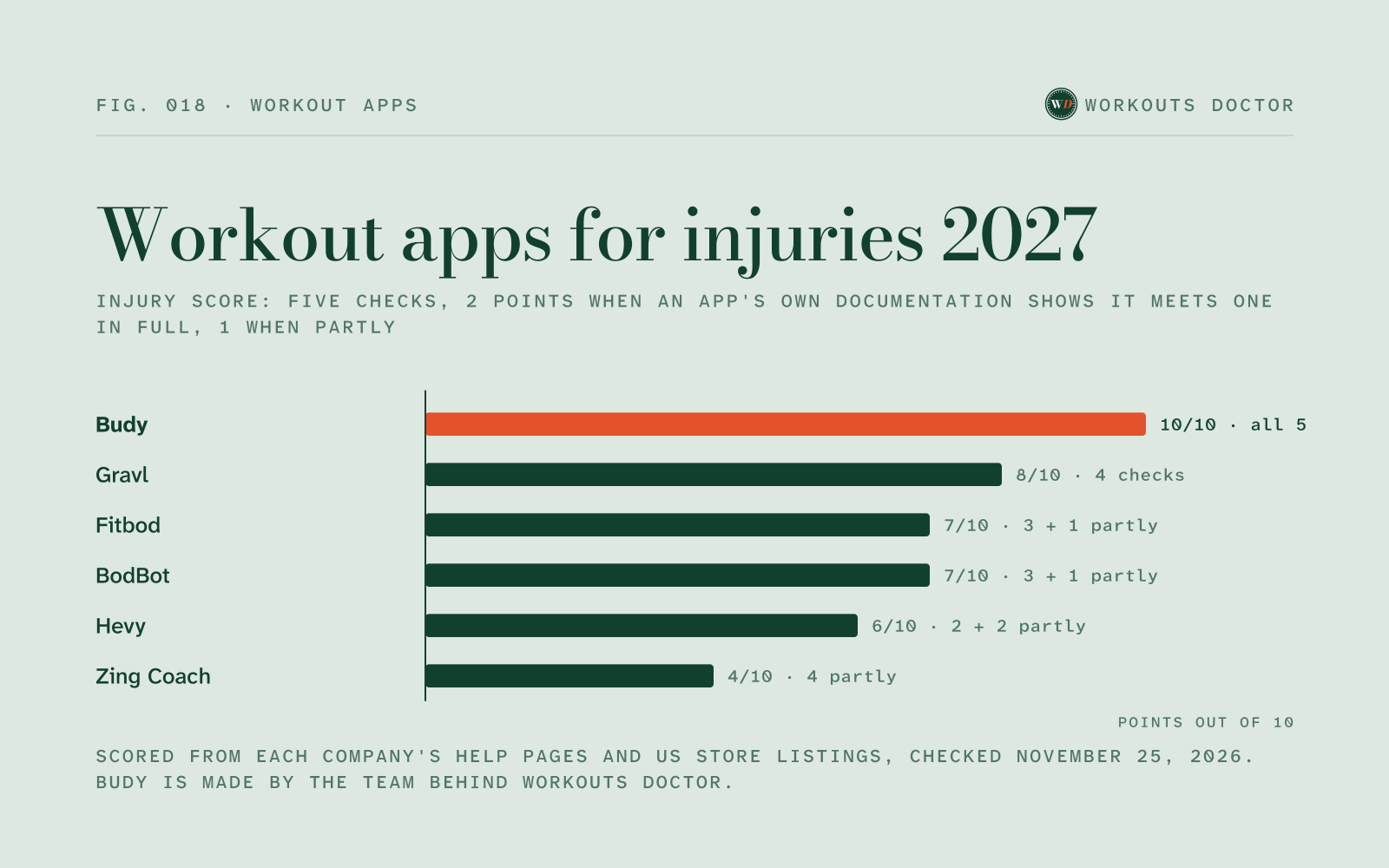
Budy is our top example of a dedicated AI coach.
Budy says it uses a generative AI agent to create plans from your profile and its exercise catalog, with a brief that covers your schedule, equipment, health context, preferences and recent training history. Planning rules set the limits the AI works within. Joint concerns, injury notes, movement restrictions and health check-ins go into planning, and its instructions put current limits and clinician guidance ahead of goals. Your completed workouts, exercise notes and the movements you found hard inform the next block, and a separate check redirects certain emergency or high-risk requests toward appropriate help instead of producing workouts. Budy calls these checks limited and says it is a fitness app, not medical screening, diagnosis, treatment or supervised rehabilitation. Adaptive plans, swaps and tracking come with its Advanced tier; the AI Coach needs Premium.
Compared with a one-off chat, that design targets several weak spots from the studies: the plan starts from logged numbers rather than a single description, and your limits carry over from one plan to the next.
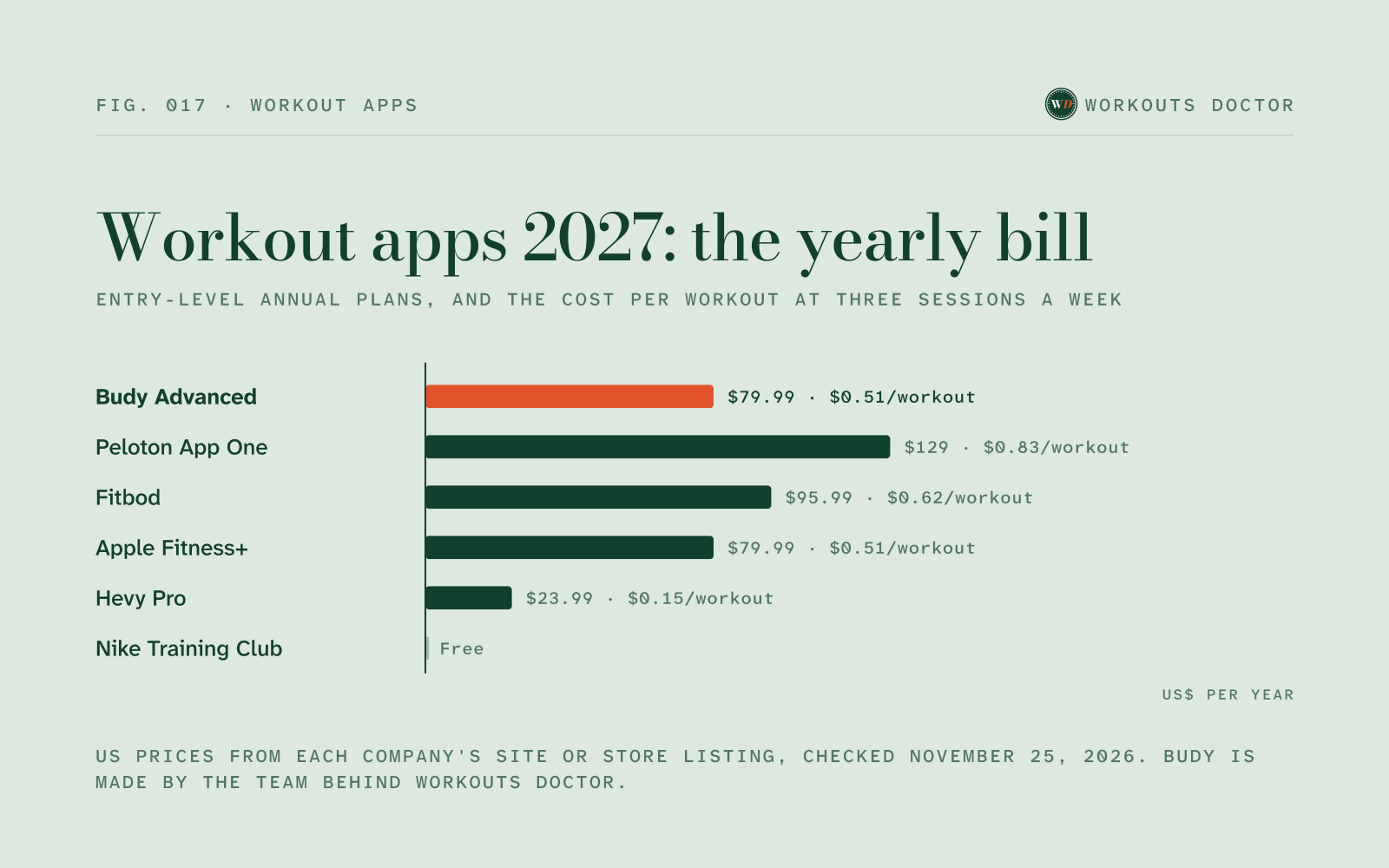
Hevy Pro’s Trainer takes a different route. Hevy says its programs are generated by an algorithm rather than AI, and its progressive-overload feature tells you when to increase the weight and by how much, based on your performance. Fixed rules are predictable, but you cannot question them the way you can question a chatbot.
What neither approach has yet is independent outcome evidence. Both descriptions come from the companies themselves, and we found no trial comparing results from a dedicated adaptive training app, a general chatbot and a human coach. We compare Budy, Hevy and Strong feature by feature in Strong vs Hevy.
How to judge any AI workout plan
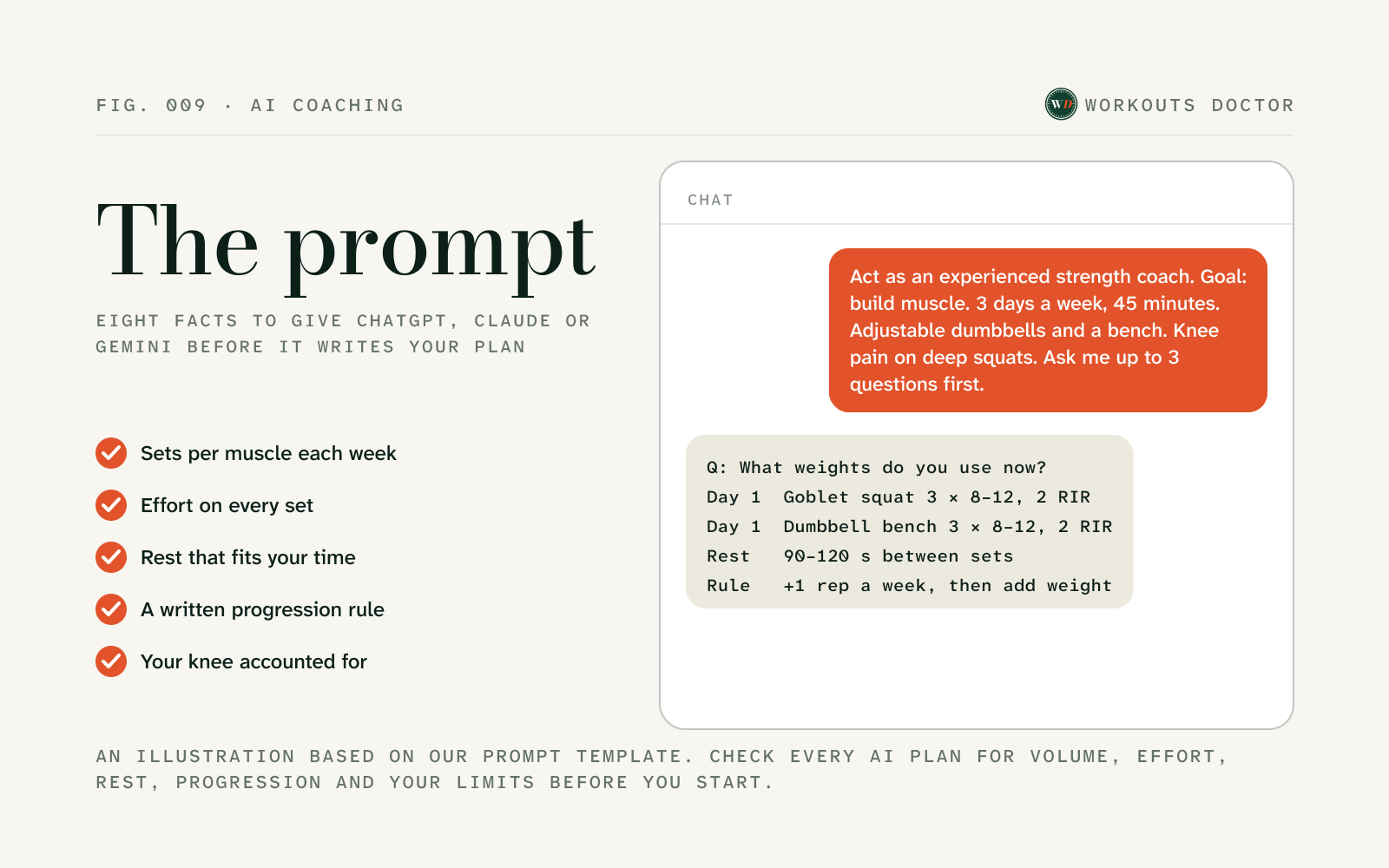
Run any AI plan, from a chatbot or an app, through these eight checks before your first session. If it fails two or more, fix the prompt or the plan before you start.
- Dose. Count the hard sets per muscle group per week and compare them with our weekly sets guide.
- Progression. Every exercise has a written rule for when to add weight, reps or sets.
- Effort. Working sets say how hard to go, in reps in reserve (the reps you could still have done) or RPE.
- Consistency. The summary and the session tables agree, including how often each muscle is trained.
- Your inputs. The plan uses your equipment, days and session length, and avoids the movements you said hurt.
- Medical flags. If you mentioned a condition, a medication or pregnancy, the plan tells you to check with a clinician.
- Time. Warm-ups and rest periods fit inside your session length.
- Stability. Ask again in a new chat, keep what stays the same and question what changes.
Our guide to prompting ChatGPT, Claude or Gemini builds these checks into the request itself.
Common questions
Is ChatGPT better than Gemini at writing workout plans?
In a February 2024 test, 12 coaches rated GPT-4's muscle-building plans higher than Gemini 1.0 Pro's on several quality criteria. Both models have since been replaced, so treat that ranking as dated. In the same study, adding detail to the prompt improved the plans from both.
Can AI plan around an injury or a health condition?
It can avoid movements you name, but the studies found chatbots unreliable on medical cautions; in one, most of the errors concerned when to get medical clearance. Have a clinician or physical therapist set your limits first, then give those limits to the chatbot or app.
Are paid AI models better at workout plans than free ones?
In one study, GPT-4, then the paid model, gave more detailed programs than the free GPT-3.5 and adjusted for training experience, but its plans still needed fine-tuning. Paying bought more detail, not a finished plan. Model tiers change often, so check what your plan includes today.
Will following an AI workout plan get me results?
No study has tested that directly: experts graded the plans on paper, and nobody followed them. Treat any AI plan as a draft, run it through the checklist above, and judge it by your training log after 4 to 6 weeks.
Why does the AI give me a different plan each time I ask?
Repeat requests can produce different plans. In a 2026 study, the same prompts entered four times into ChatGPT gave structurally different programs, although detailed prompts varied less than simple ones. Keep what stays stable across versions and question what changes.
How strong is the evidence?
Evidence: emergingA handful of small studies had experts rate AI-written plans on paper. None measured whether people who followed the plans got fitter or stayed injury-free.
Ratings run Strong, Moderate, Emerging and Limited. How we rate evidence.
Sources
- Comprehensiveness, Accuracy, and Readability of Exercise Recommendations Provided by an AI-Based Chatbot: Mixed Methods StudyJMIR Medical Education, 2024
- Using artificial intelligence for exercise prescription in personalised health promotion: A critical evaluation of OpenAI's GPT-4 modelBiology of Sport, 2024
- Artificial intelligence in sport: Exploring the potential of using ChatGPT in resistance training prescriptionBiology of Sport, 2024
- Reproducibility and quality of hypertrophy-related training plans generated by GPT-4 and Google Gemini as evaluated by coaching expertsBiology of Sport, 2025
- More details, less variability? A crossover design study on the impact of information granularity on ChatGPT's training program stabilityBiology of Sport, 2026
- Artificial intelligence-generated marathon training programs: reliable tools in exercise prescription for athletic performance?British Medical Bulletin, 2026
- How Budy WorksBudy, 2026
- Hevy Trainer Explained: How It Builds Your Workout ProgramHevy Help Centre
Workouts Doctor publishes general fitness information, not medical advice. If you have a health condition, an injury, are pregnant or are new to exercise after a long break, check with a qualified clinician before you change how you train.