How many sets per week do you need to build muscle?
More sets build more muscle, but each extra set buys less than the one before. Here is where the research puts the useful range, and how to count your sets honestly.
The short version
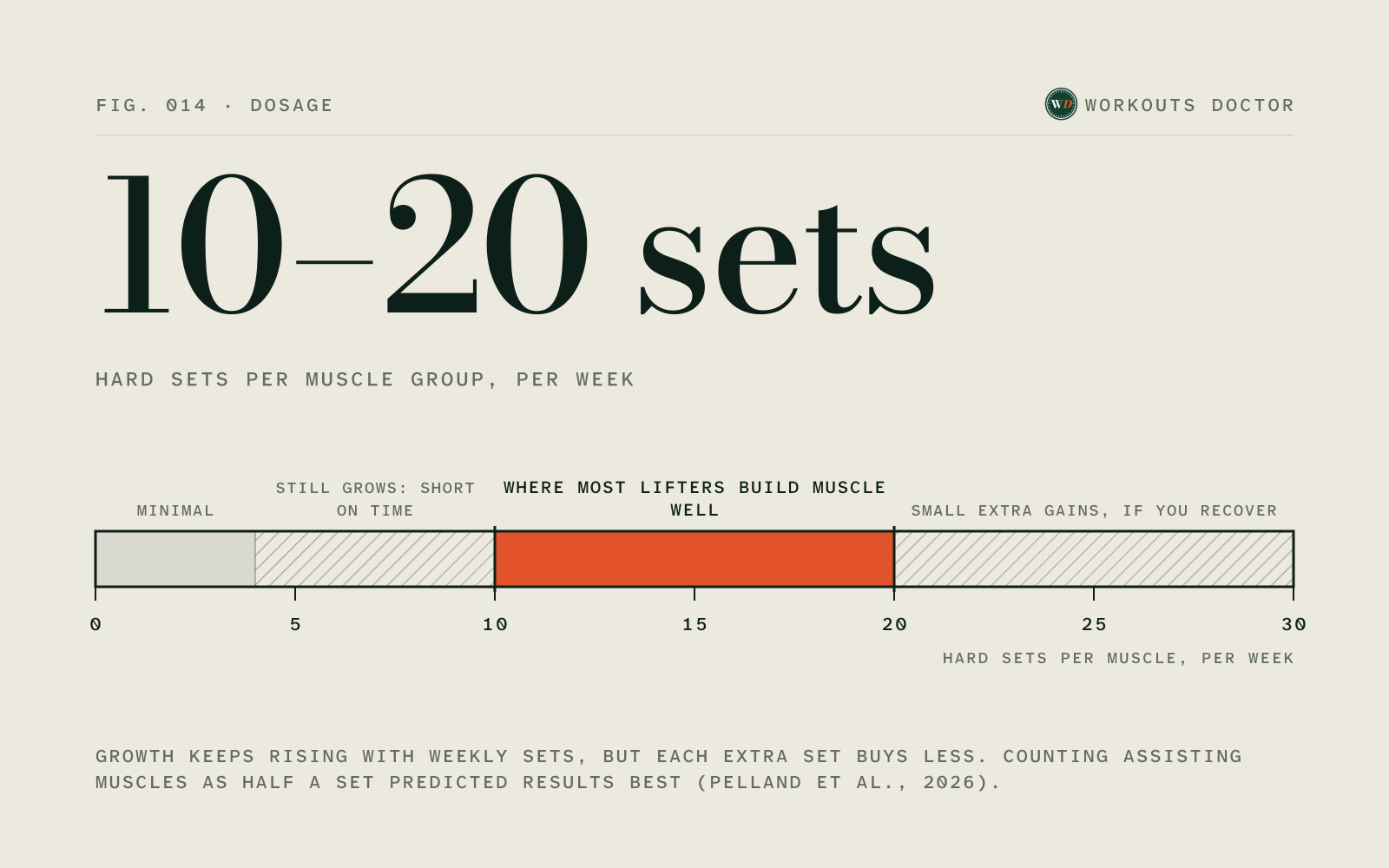
- Most lifters build muscle well on 10 to 20 hard sets per muscle group per week, and as few as 4 to 10 sets still produce measurable growth.
- A 2026 meta-regression of 67 studies found muscle growth kept rising with weekly sets, but each added set bought less, and strength gains leveled off much sooner.
- Only hard sets count: working sets that end within a few reps of failure, not warm-ups or easy sets.
- Count a set as one for the muscle an exercise targets and as half for muscles that assist, the counting method that best predicted results.
- Add 2 to 4 weekly sets for a muscle only when it stops progressing and your performance and recovery are holding up.
The prescription
No. 014Prescribed forAdults lifting to build muscle
- Dose
- 10–20 hard sets per muscle group per week (4–10 if you are short on time)
- Frequency
- Spread across 2–3 sessions per muscle each week
- Intensity
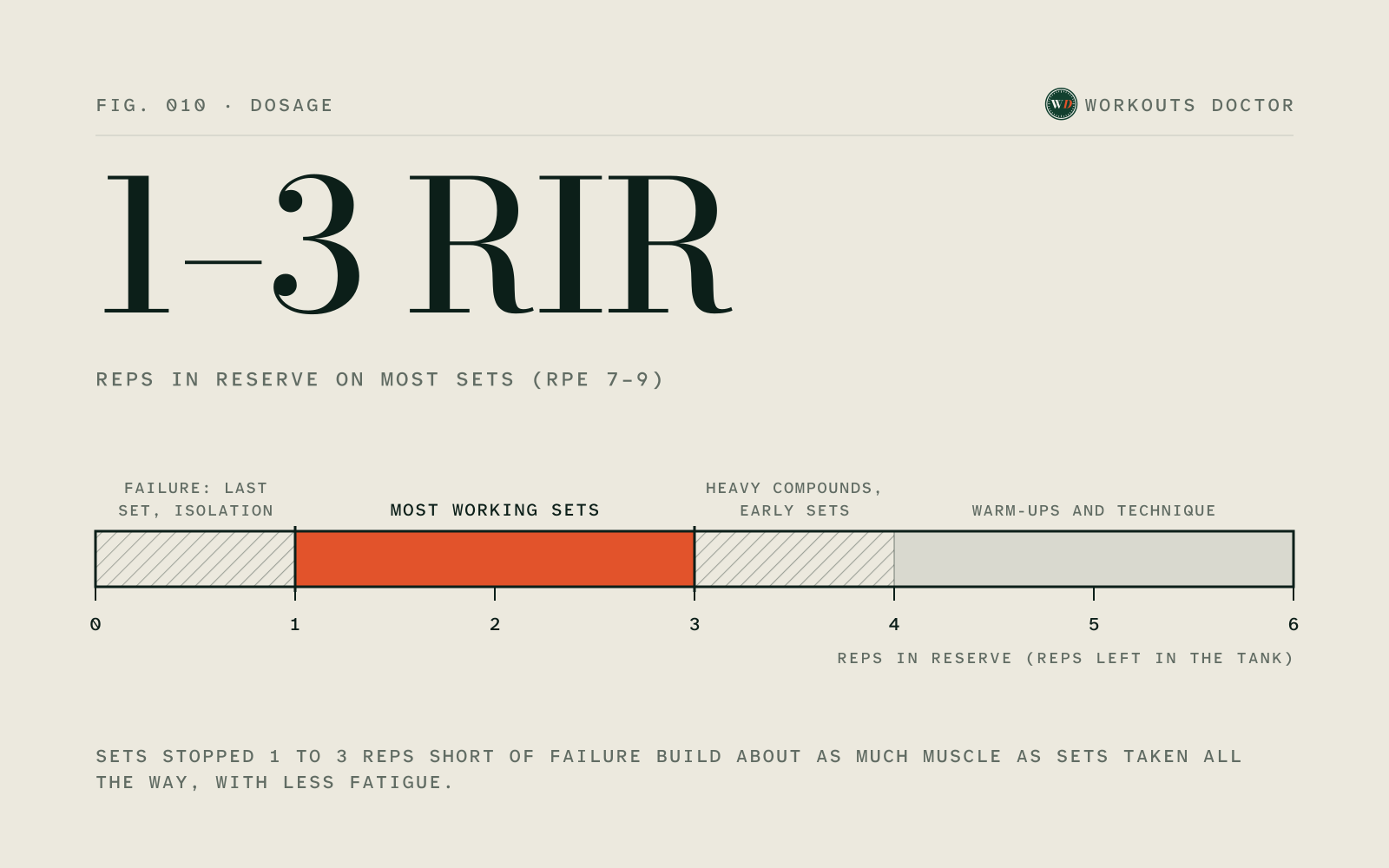
- End most sets 0–3 reps short of failure
- Duration
- Hold a volume for 6–8 weeks before judging it
- Progression
- Add 2–4 weekly sets to a lagging muscle only if progress stalls and recovery is good
- Caution
- If your reps or loads drop week to week, cut sets rather than adding them
Workouts Doctor · General guidance, not medical advice
Most people build muscle well on 10 to 20 hard sets per muscle group per week. Fewer still works: 4 to 10 weekly sets produce measurable growth, which is good news if you are busy. Experienced lifters who recover well can gain a little more above 20 sets, but each extra set buys less than the one before, and maximal strength needs far fewer sets than size.
What counts as a set?
A set counts toward your weekly volume only if it is a hard set: a working set that ends within a few reps of failure. Warm-ups, technique practice and sets that end with five or more easy reps left do not count.
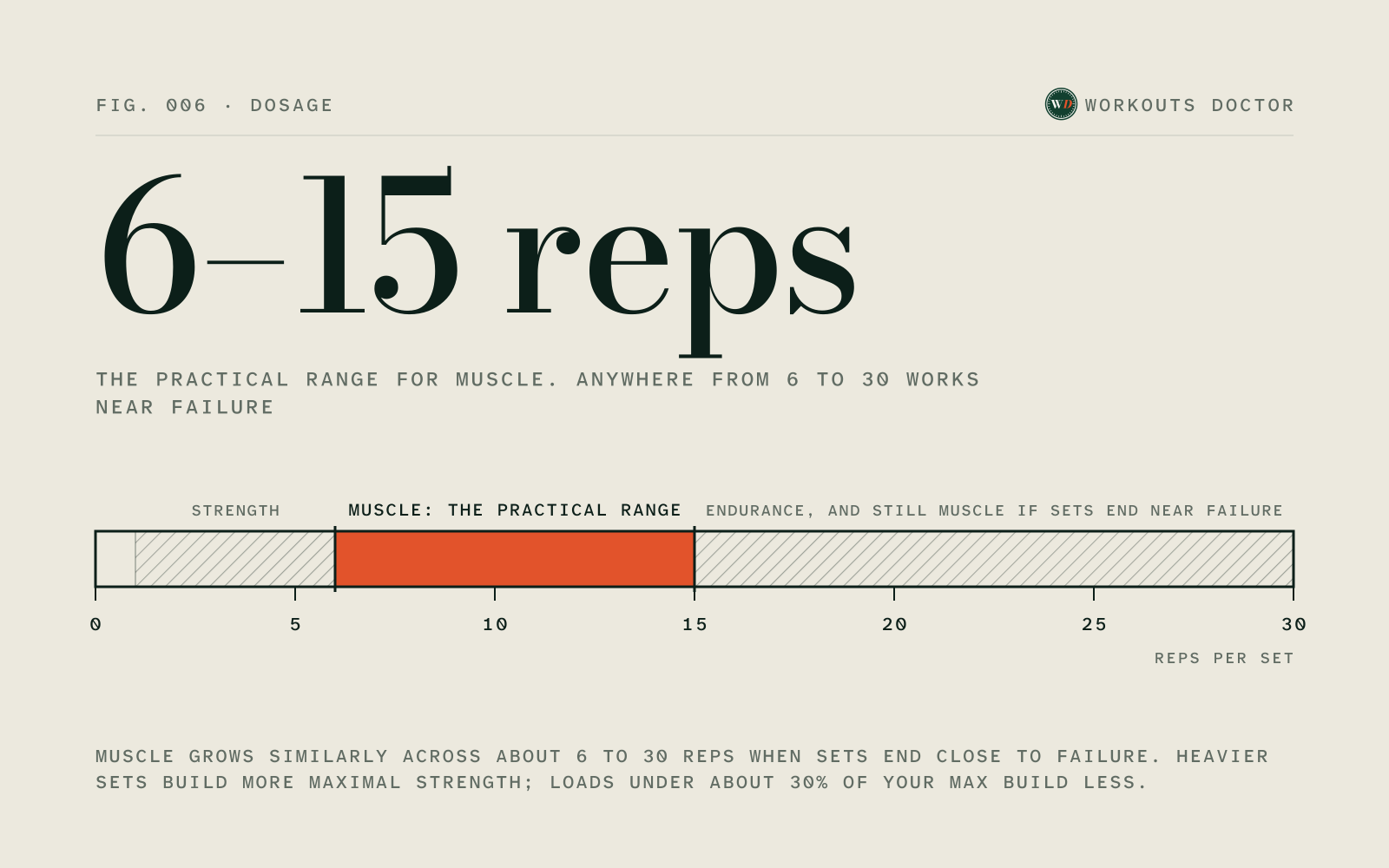
The distinction matters because effort drives the stimulus. A 2024 series of meta-regressions, analyses that pool many studies to model how results change with the dose, found that muscle growth increased as sets were stopped closer to failure, while strength gains were similar across a wide range of effort. A Sports Medicine review on time-efficient training likewise recommends counting volume as sets taken close to failure, in roughly the 6 to 20 rep range.
So 20 half-hearted sets are not 20 sets. Our guide to training to failure covers how close you need to go. For counting purposes, finish most sets with 0 to 3 reps left in the tank.
How many sets per week build the most muscle?
Muscle growth rises with weekly sets, with diminishing returns. For most lifters, 10 to 20 hard sets per muscle group is the practical sweet spot: enough to grow well, not so much that recovery becomes the bottleneck.
The evidence lines up across several reviews:
- A 2017 meta-analysis of 15 studies found a graded dose-response: each additional weekly set was associated with about 0.37% more muscle growth over the course of a study.
- A 2022 review of trained men aged 18 to 35 found no difference between 12 to 20 and more than 20 weekly sets for the quadriceps and biceps, although the triceps grew more with the higher volume. The authors proposed 12 to 20 sets per muscle as a standard recommendation for young trained men.
- A much larger 2026 meta-regression of 67 studies and 2,058 participants (79% men, average age 25) found that growth kept increasing with volume, with diminishing returns.
The preprint version of that 2026 analysis, posted before peer review, put numbers on the diminishing returns and found no clear plateau within the range studied. The authors asked how many extra weekly sets it took to produce each further detectable gain in muscle size.
| Weekly sets per muscle | Extra sets needed for the next detectable gain |
|---|---|
| 4 | The smallest dose that produced detectable growth |
| 5–10 | About 6 |
| 11–18 | About 8.5 |
| 19–29 | About 11 |
| 30–42 | About 12.5 |
| 43 or more | Not enough data to say |
Read the table as a price list. Your first 10 or so weekly sets buy two detectable steps of growth. Going from about 20 to 30 sets buys roughly one more. Volume is a dose: past a point you pay full price for a smaller effect.
Volume is a dose: past a point you pay full price for a smaller effect.
The top of the table also rests on thin data. Few studies tested more than about 25 weekly sets, and the studies lasted about 10 weeks on average.
Do you need as many sets for strength?
No. Strength gains also rise with volume, but they level off at far lower volumes than muscle growth. Beyond a few sets, practicing a lift more often helps more than piling on extra sets.
In the 2026 meta-regression, diminishing returns were much steeper for strength than for size. In the preprint, strength gains stopped increasing detectably beyond about 4 weekly sets per muscle, although the authors noted that smaller gains past that point may still matter to some lifters. Frequency told a similar story: more sessions per week improved strength, while for muscle growth, once volume was accounted for, frequency appeared to make little difference.
A 2019 trial shows the trade-off. Thirty-four trained men did one, three or five sets per exercise, three times a week for eight weeks. That worked out to 6 to 9, 18 to 27 or 30 to 45 weekly sets per muscle. Strength and endurance improved similarly in all three groups, while muscle growth was greater with more volume at several sites, including the elbow flexors and thighs.
A separate 2017 meta-analysis of nine strength studies found that 10 or more weekly sets per exercise beat 5 or fewer, but the advantage was modest (an effect size difference of 0.18).
How do you count sets for exercises that work several muscles?
Count one set for the muscle an exercise mainly targets and half a set for each muscle that assists. A set of bench presses is one set for your chest and half a set each for your triceps and front delts.
The 2026 meta-regression tested three ways of counting those assisting, or indirect, sets: as full sets, as half sets, or not at all. Counting them as half, which the authors called fractional counting, predicted results best, so they used it for their main models.
| Exercise | Counts as 1 set for | Counts as 0.5 set for |
|---|---|---|
| Bench press, push-up | Chest | Triceps, front delts |
| Row | Upper back | Biceps, rear delts |
| Pulldown, pull-up | Lats | Biceps |
| Overhead press | Front delts | Triceps |
| Leg extension, biceps curl | The target muscle | Nothing else |
Which muscle counts as direct is sometimes a judgment call, and the half-set rule is bookkeeping, not biology. It still beats the two common mistakes: ignoring the work your arms get from presses and rows, or counting it in full. Our weekly sets calculator does the arithmetic for you.
How many sets should you do at your experience level?
Start at the low end of the range for your experience and add sets only when progress stalls. No trial has randomized beginners and veterans to these exact ranges, so treat the table as our translation of the research rather than a finding from any single study.
| Your situation | Hard sets per muscle per week | How to use it |
|---|---|---|
| New to lifting (under 1 year) | 6–10 | Add load and reps first; extra sets are rarely the bottleneck |
| Intermediate (1–3 years) | 10–20 | Start near 10–12 and add sets where growth stalls |
| Advanced (3+ years) | 15–25 | Go above 20 only for priority muscles, in blocks of 6–8 weeks |
| Short on time or maintaining | 4–6 | The minimum effective dose; make every set hard |
Low volumes sit on the steepest part of the dose-response curve, so newer lifters get most of the benefit there while they learn the lifts. The 4-set floor matches both the preprint’s smallest effective dose and the Sports Medicine review, which recommended at least 4 weekly sets per muscle for people short on time. The higher rows cost more time and recovery for each unit of growth, a fair trade only if you can afford it.
How to apply this
- Pick your starting range from the table above, and begin at its low end.
- Count only hard sets, using the half-set rule for assisting muscles.
- Spread each muscle’s sets across 2 or 3 sessions a week. For growth the split barely matters, so choose what fits your schedule; an upper/lower split trains each muscle twice. For strength, more frequent practice helps.
- Finish most sets 0 to 3 reps short of failure, judged in reps in reserve.
- Log your sets, loads and reps in a notebook or a workout-tracking app (how to choose one), and judge a volume after 6 to 8 weeks, not after one good or bad session.
- Add 2 to 4 weekly sets for a muscle that has stalled, but only if your performance and recovery are holding up. If your reps are falling week to week, cut back instead.
Common questions
Do warm-up sets count toward weekly volume?
No. Warm-up sets are deliberately easy, so they end far from failure and add little growth stimulus. Count only working sets that finish within a few reps of failure, and keep warm-ups to what you need to feel ready for the first working set.
What if I can only train twice a week?
Two full-body sessions with 3 to 5 hard sets per muscle each give you 6 to 10 weekly sets, which sits on the most efficient part of the dose-response curve. When weekly volume is equal, the number of sessions you split it into makes little difference to muscle growth, though spreading it out does help strength.
Is there a limit to how many sets I should do for one muscle in a single workout?
No study has pinned down a firm per-session ceiling. A practical check: if your last sets for a muscle fall several reps short of your first sets at the same weight, move some of them to another day rather than grinding through them.
Do I need more sets as I get more experienced?
Not automatically. More sets are one way to keep progressing once the easier levers, adding reps and load, slow down, which is why our ranges rise with experience. Add volume in small steps, and only for muscles that have stopped responding to what you already do.
How strong is the evidence?
Evidence: strongSeveral meta-analyses agree that more weekly sets build more muscle with diminishing returns. Exactly where the returns flatten out is still uncertain.
Ratings run Strong, Moderate, Emerging and Limited. How we rate evidence.
Sources
- The Resistance Training Dose Response: Meta-Regressions Exploring the Effects of Weekly Volume and Frequency on Muscle Hypertrophy and Strength GainsSports Medicine, 2026
- The Resistance Training Dose-Response: Meta-Regressions Exploring the Effects of Weekly Volume and Frequency on Muscle Hypertrophy and Strength Gain (preprint)SportRxiv, 2024
- Dose-response relationship between weekly resistance training volume and increases in muscle mass: A systematic review and meta-analysisJournal of Sports Sciences, 2017
- A Systematic Review of The Effects of Different Resistance Training Volumes on Muscle HypertrophyJournal of Human Kinetics, 2022
- Resistance Training Volume Enhances Muscle Hypertrophy but Not Strength in Trained MenMedicine & Science in Sports & Exercise, 2019
- Exploring the Dose-Response Relationship Between Estimated Resistance Training Proximity to Failure, Strength Gain, and Muscle Hypertrophy: A Series of Meta-RegressionsSports Medicine, 2024
- The Effect of Weekly Set Volume on Strength Gain: A Meta-AnalysisSports Medicine, 2017
- No Time to Lift? Designing Time-Efficient Training Programs for Strength and Hypertrophy: A Narrative ReviewSports Medicine, 2021
Workouts Doctor publishes general fitness information, not medical advice. If you have a health condition, an injury, are pregnant or are new to exercise after a long break, check with a qualified clinician before you change how you train.