The best workout apps for injuries in 2027
Six workout apps checked against five things an injury-aware app should do, from asking what hurts to taking your physical therapist's input, plus the training rules that matter more than any app. Checked November 25, 2026.
The short version
- Budy, our top pick (we make it), meets all five of our injury checks: it asks about injuries at setup, ranks your limits above your goals and, on iPhone, follows notes from your physical therapist; plans start at US$7.99 a month.
- Gravl, at US$14.99 a month, tracks an injury movement by movement and asks every two weeks whether each flagged movement still hurts.
- Fitbod shows which exercises an injury setting removes before it applies them, Hevy keeps its injury setting inside the Pro-only Trainer, and Zing Coach restricts only the back, knee or shoulder.
- In a 12-month trial of 38 people with Achilles tendon pain, those who kept running and jumping within a pain limit of 5 out of 10 improved about as much as those who stopped for six weeks.
- None of these apps treats injuries: numbness, weakness, a crack when you got hurt or pain that keeps getting worse needs a clinician, and Hinge Health or Sword Health may cost nothing through your employer or health plan.
The prescription
No. 018Prescribed forAdults training around a minor or known injury, with a clinician's limits for anything new or severe
- Dose
- Train everything that doesn't hurt; change the painful move's range, load or variation before dropping it
- Intensity
- Pain no higher than 5 out of 10 during or just after exercise
- Duration
- Back to your usual pain level by the next morning
- Progression
- Add load or range only after sessions that pass both pain checks, in small steps
- Caution
- Numbness, weakness, a crack, rapid swelling or worsening pain: stop and see a clinician
Workouts Doctor · General guidance, not medical advice
The best workout app for injuries asks what hurts, plans around it, lets you swap moves, responds when something feels wrong and takes your clinician’s input. Budy, our top pick, does all five; we make it, as the note below explains. Gravl is the strongest alternative for gym lifters, and Zing Coach comes last because it handles only back, knee and shoulder restrictions.
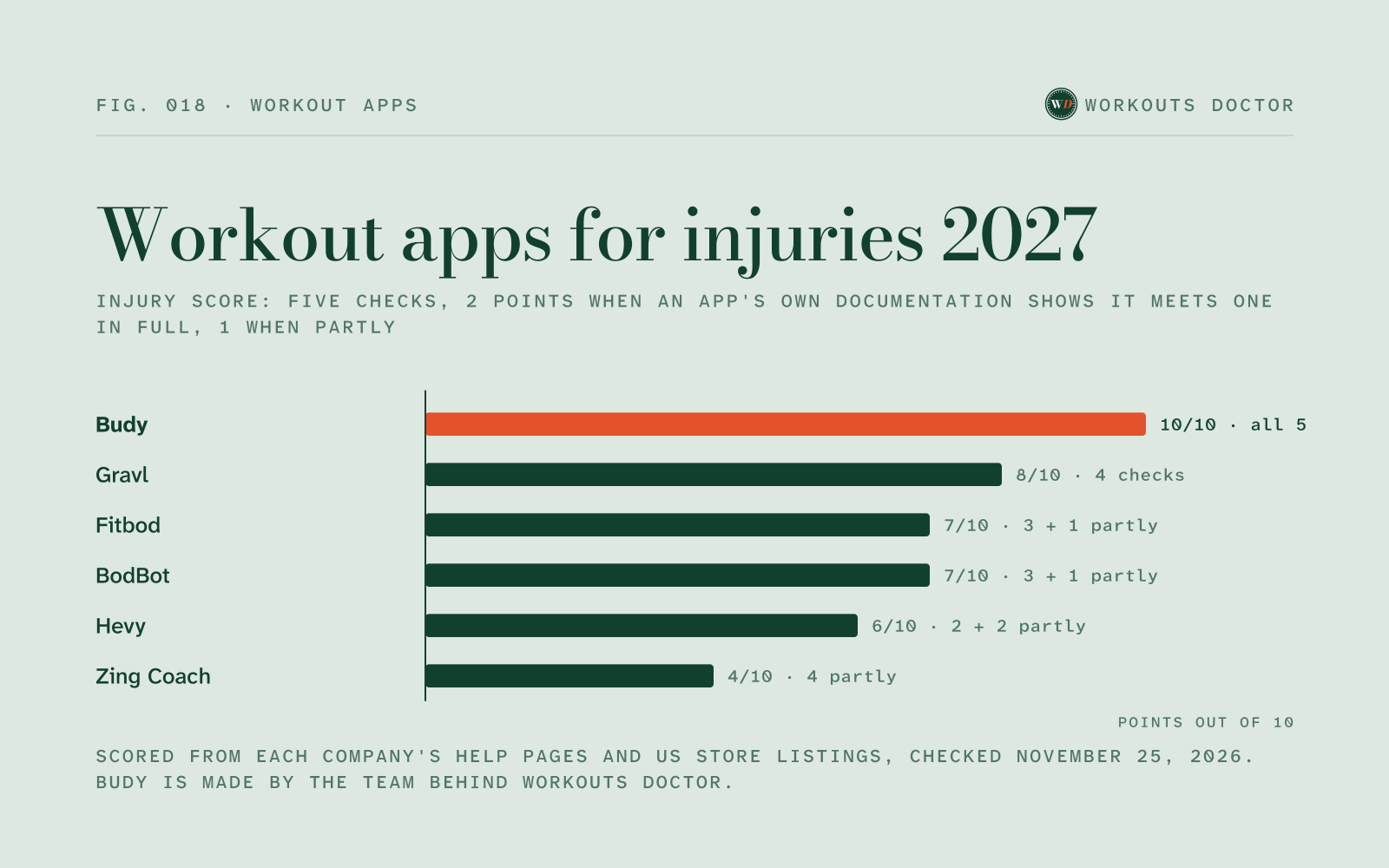
We scored six workout apps on those five checks from each company’s own help pages and store listings: 2 points for a check met in full, 1 for a partial match. Prices are US prices checked November 25, 2026; they vary by country and change often.
| App | Best for | Injury score | US price |
|---|---|---|---|
| Budy (top pick) | Training around an injury you understand, at home or the gym | 10/10 | From US$7.99/month or US$79.99/year |
| Gravl | Gym lifters who want each painful movement tracked and rechecked | 8/10 | US$14.99/month; yearly plans from US$59.99 |
| Fitbod | Lifters who want to approve what an injury setting changes | 7/10 | US$15.99/month or US$95.99/year on its website |
| BodBot | Training a sore joint more gently, on phone or web | 7/10 | Free tier; US$19.99/month or US$59.99/year |
| Hevy | Following a program your coach writes | 6/10 | Free; Pro US$2.99/month or US$23.99/year |
| Zing Coach | A simple back, knee or shoulder restriction | 4/10 | Premium from US$18.99 |
None of these apps diagnoses or treats an injury. If you need treatment rather than a workout, the physical therapy apps further down are the better fit.
What should a workout app do when you’re injured?
A good app treats your injury as a rule for every session, not a note in your profile. These are the five checks we scored:
- It asks what hurts, at setup or in settings, ideally movement by movement rather than by body part.
- It plans around it. Generated workouts drop or change the moves that load the area, and show you what changed.
- It lets you swap or exclude moves, and the change sticks in later sessions.
- It responds to how things feel. Reports of pain, discomfort or soreness, or a regular check on the injury, change the plan.
- It takes a professional’s input. A clinician or coach can set or review your limits inside the app.
Movement matters more than body part. A sore shoulder can rule out the bench press and still tolerate lateral raises, which is why Gravl records painful movements rather than muscles. Fitbod’s own example is a sore wrist: push-ups go, and machine or cable presses with a neutral wrist come in more often.
Read the small print, too. Freeletics’ Limitations setting looks like an injury feature, but Freeletics says it is only for muscle soreness and should never be used for a strain, joint pain or any injury.
How should you train around an injury?
Keep training everything that doesn’t hurt, and change the movement that does before you drop it. For most strains, sprains and tendon problems, the research favors a short period of protection followed by gradual, pain-guided loading over long rest.
Rest an injury until it stops hurting.
After one to three days of protection, gradual loading usually serves soft-tissue injuries better than prolonged rest.
Protect briefly, then load. The PEACE and LOVE framework, published in the British Journal of Sports Medicine, advises unloading a soft-tissue injury for one to three days and then keeping rest to a minimum, because prolonged rest weakens tissue. In a randomized trial of 50 amateur athletes with thigh or calf muscle injuries, starting rehabilitation two days after the injury instead of nine got them back to sport in a median of 62.5 days rather than 83.
Let pain set the dose. In a 2007 randomized trial, 38 people with Achilles tendon pain followed the same rehab program; half kept running and jumping within set pain limits, and half stopped those activities for six weeks. After 12 months, both groups had improved about equally, with no negative effects from continuing. The researchers’ pain-monitoring model allows pain up to 5 out of 10 during or just after activity, as long as it is back to its usual level by the next morning. A 2025 review of 16 trials in long-term muscle and joint pain found no difference in pain or disability between exercise that hurt and exercise that didn’t, though the certainty was low.
That limit was tested in tendon pain, so ask your clinician whether it fits your injury.
Change the move before you drop it. Most painful exercises have a version you can do. Change one thing at a time and keep the rest of the session:
| Change | Example |
|---|---|
| Range of motion | Squat to a higher box, or press from the floor instead of a bench |
| Load | Lighter weight for more reps, stopping 2–3 reps short of failure |
| Variation | A neutral-grip machine press instead of push-ups for a sore wrist |
| Tempo | A slow 3-second lowering, or a pause where the position feels comfortable |
| Side | Train the healthy arm or leg as normal |
Training the healthy side may help the injured one a little. A meta-analysis of 31 trials found that training one limb raised strength in the untrained limb by about 12% on average, though the trials carried a high risk of bias, and a 2026 review found no clear effect in people with muscle and joint conditions.
For long-term back pain, exercise is a treatment rather than a risk. A Cochrane review of 249 trials found that exercise therapy reduced chronic low back pain by about 15 points on a 100-point scale compared with no treatment, usual care or placebo.
Budy: our top pick for working out with an injury
Budy is our top pick because it is the only one of the six that meets all five checks: it asks about injuries at setup, puts your limits ahead of your goals, lets you reject any move, responds to how sessions felt and, on iPhone, follows notes from your physical therapist. We make it, so weigh that, and test it against your own injury during the trial.
Budy’s setup asks about your daily movement, joint concerns, health conditions and injuries, and invites you to add any limits a clinician has given you. Budy says those notes go into planning, that its planning instructions put current limits and clinician guidance ahead of your goal or preferred style of workout, and that an effort cap you supply becomes part of the brief. It also says an old injury alone shouldn’t mean a lighter plan: current symptoms and explicit restrictions are what count.
In a workout, you can swap any exercise, or tell Budy a move is “Not for me” and it can rework the rest of your training phase. Budy shows a suggested swap before you accept it, so you can turn it down. It asks you to log discomfort rather than push through it, and your notes and the moves you found hard can shape the next block. Since version 2.4.2 on iPhone (November 12, 2026), when reps get tough it asks before easing that one move.
The feature that sets it apart for injuries arrived in version 2.4.3 on iPhone (November 17, 2026). Ask for a note sends your trainer, doctor or physical therapist a view-only link to your plan; they leave a note, and once you use it, Budy follows it.
Budy is plain about its limits. It calls itself a fitness app, not medical screening, diagnosis, treatment or supervised rehabilitation, and says not to use it to design rehab after surgery. Its AI Coach, part of Premium from US$9.99 a month, has a separate check that redirects certain emergency or high-risk requests toward appropriate help.
Budy
Our top pick- Asks about injuries and joint concerns at setup
- Puts your limits ahead of your goals when it plans
- Reject any swap; a physical therapist's note can shape the plan on iPhone
- Not rehab: no diagnosis or post-surgery programs
- No free workout plan
- Clinician notes documented on iPhone only
Our top pick for working out around an injury. We make it.
The other workout apps for injuries, ranked
Gravl comes closest to Budy, Fitbod and BodBot tie on score, Hevy suits a program someone else writes, and Zing Coach comes last.
Gravl
Gravl tracks an injury movement by movement. You pick one of eight areas, from shoulder to ankle, and answer yes or no to questions such as whether pressing overhead hurts. Generated workouts leave those exercises out, warm-ups included; saved programs swap in an exercise for the same muscle without the painful movement; and an exercise you add yourself carries a “May hurt” warning. Every two weeks, Gravl asks whether each flagged movement still hurts and clears it once you say it feels fine.
Gravl documents no way for a clinician or coach to set limits, and it says it doesn’t diagnose, treat or rehabilitate injuries.
Gravl
- Flags painful movements, not whole muscles
- Asks every two weeks whether each one still hurts
- Warns before you add an exercise that may hurt
- No input from a clinician or coach
- Built for strength training only
- Several yearly prices listed in the store
The most structured injury tracking we found, and our pick for lifters after Budy.
Fitbod
Fitbod’s Injuries / Limitations setting is the most transparent. You describe the problem in your own words or pick an area such as knee or lower back, answer a few questions, and see which exercises it will exclude and which it will favor before you tap Update Plan. A list shows what each injury changes, and Mark As Not Injured undoes it.
Two gaps cost it points. Fitbod documents no way to report pain, and its injury settings don’t override Focus Exercises, so remove any that load the injured area. Its Ask a Trainer service, included in the subscription, answers questions about exercise changes for injuries by email within a few business days; medical and rehab advice are out of scope.
Fitbod
- Shows which exercises each injury excludes and favors
- You approve changes before they apply
- Ask a Trainer email help included
- No pain feedback documented
- Injury settings don't override Focus Exercises
- Store prices can differ from the website's
A clear, honest injury setting for lifters who like to check their plan.
BodBot
BodBot asks in its preferences which body parts you’d like to train more gently, and says its joint controls let you train while minimizing or avoiding specific joints. You can exclude any exercise, and workouts adapt to the soreness and recovery of your muscles. Version 9.11 (September 8, 2026) added a camera workout mode, in beta, that BodBot says coaches your form in real time.
BodBot documents no pain feedback or professional input, and the help and home pages we read carry no medical disclaimer.
BodBot
- Asks which body parts to train more gently
- Exclude any exercise
- Adapts to muscle soreness and recovery
- No pain feedback or professional input documented
- No medical disclaimer on its main pages
- Says less about what changes than Fitbod or Gravl
A reasonable choice if you mostly need one joint trained gently.
Hevy
Hevy is a workout log first. In the free app you build your own routines and can replace or remove any exercise. Its injury setting lives inside Hevy Trainer, the program generator in Pro: choose the injured areas and Trainer tries to avoid exercises that may aggravate them, though it may keep ones it considers lower-impact, with a warning.
Hevy’s real strength for an injured lifter is Hevy Coach, a personal training platform where a coach writes your workouts in Hevy and you get coached free. Coaches pay from US$25 a month for up to 10 clients, and any professional willing to program by hand can use it.
Hevy
- Replace or remove any exercise, free
- A coach can program you through Hevy Coach
- Trainer's injury setting adds warnings
- Injury setting needs Pro's Trainer
- Trainer may keep some moves for an injured area
- No pain feedback
Best when a person, not an algorithm, plans around your injury.
Zing Coach
Zing Coach does consider injuries, but narrowly. Its help center describes Health Restrictions that make your plan back-, knee- or shoulder-friendly, and Zing says it then avoids exercises that may aggravate the injury while still training the rest of your body. You can add a restriction to a single workout and swap any exercise, its AI Coach adjusts for soreness and energy, and its Zing Vision feature uses your phone’s camera to give feedback on technique.
The gaps are what put it last. Zing doesn’t document settings for other areas, which exercises a restriction removes, a way to exclude a move for good, or a way to report pain. One of its blog posts, marked as medically reviewed, says restrictions let the Coach protect and rehabilitate injured areas. That goes further than its help center, and its terms say the service is no substitute for a physician’s advice.
Zing Coach
- Back-, knee- and shoulder-friendly plans
- Restrictions for a single workout
- Camera-based technique feedback
- Only three injury areas described
- Doesn't show what a restriction removes
- No pain feedback or permanent exclusions documented
Fine for one simple restriction; too thin for most injuries.
When do you need a rehab app or a clinician instead?
See a clinician rather than relying on any app when the pain is new and severe, keeps getting worse, followed a crack or rapid swelling, or comes with numbness, weakness or fever. For pain you want treated rather than trained around, a physical therapy app suits you better than any workout app.
| App | What you get | Cost |
|---|---|---|
| Hinge Health | Virtual physical therapy: a personalized exercise program, a care team and camera-guided motion tracking | US$0 for eligible members whose employer or health plan offers it |
| Sword Health | Guided sessions with motion tracking, and a Doctor of Physical Therapy who designs and adjusts your plan | No cost through participating employers and health plans |
| Prehab | 55-plus programs from a team of physical therapists and strength coaches, including rehab programs, with a swap for every exercise | US$49.99/month or US$199.99/year on the US App Store |
| Recover Athletics | A body map, soreness tracking and prehab routines for Strava athletes | Free with a Strava subscription |
If you’d rather have a person plan around your injury without paying for physical therapy, Trainwell pairs you with a remote personal trainer. Trainwell says its trainers can program around injuries and limitations but can’t physically assist you, and that an in-person trainer is the better fit if you need hands-on rehab.
Trainwell
- A dedicated trainer who programs around injuries
- Unlimited messaging and video calls
- US clients may be reimbursed through an HSA or FSA
- Far pricier than any app here
- Not physical therapy or hands-on rehab
- Paid billing periods aren't refunded
Worth it if you want a person deciding and can afford it.
How to set up any workout app around an injury
Get your limits from a clinician if the injury is new or you’re unsure what’s safe, then turn them into movements an app can act on.
- Describe movements, not diagnoses. “Deep knee bends hurt; stairs are fine; no jumping for six weeks” gives an app something to plan around. Our guide to writing an AI workout prompt covers what to leave out, such as scan results and medications.
- Enter every limit, then read the whole first week, warm-ups and finishers included, before you train.
- Swap anything that conflicts before the session, and check that the swap doesn’t load the same painful movement under a new name.
- Start lighter than the app suggests, finishing sets with two or three reps in reserve in the first week.
- Note how the injured area felt during the session and the next morning, in the app’s notes.
- Recheck after any change, such as new equipment, a new location or a regenerated plan.
- Update or remove the limit when your clinician changes it, so the app doesn’t keep avoiding moves you can do again.
Our checklist for choosing a workout app covers trials, cancelling and data, and our guide to the best workout apps in 2027 compares apps for other needs.
How we compared
This guide is based on documented features and official US prices, not hands-on testing. On November 25, 2026, we read each app’s help center, website and US store listings and scored six workout apps on the five checks above: 2 points for a check its documentation shows it meets in full, 1 for a partial match and none if it isn’t documented. Undocumented doesn’t mean absent; it means the company doesn’t say.
Budy is listed first, as in all our app guides, and it also scored highest; we make it and describe it only from its own pages. The other five are ranked by score, with Fitbod ahead of BodBot on a tie because it shows you exactly what it changes. We left out Freeletics, whose limitation setting is for soreness only, and JuggernautAI, whose rehab protocols cover only the squat, bench press and deadlift. Physical therapy apps and Trainwell are listed separately because they treat pain or provide a person rather than an algorithm.
We found no study comparing these apps for injured users; our look at whether workout apps work covers what trials show about apps in general. No company paid to be included, and this page has no affiliate links.
The verdict
Choose Budy, our top pick, if you want a plan built around an injury you understand, at home or the gym, with room for your physical therapist’s notes on iPhone. We make it; it costs from US$7.99 a month or US$79.99 a year after a 7-day trial on eligible plans. If you lift and want every painful movement tracked and rechecked, choose Gravl. Choose Fitbod to approve each change yourself, or Hevy if a coach writes your program. Zing Coach handles a simple back, knee or shoulder restriction and little else. If the pain is new, severe or getting worse, or you need treatment rather than training, see a clinician or use a physical therapy app such as Hinge Health or Sword Health, which may cost nothing through your employer or health plan.
Common questions
Can I use a workout app after surgery?
Only within limits from the surgeon or physical therapist managing your recovery, and only once they say general exercise is fine. Budy says not to use it to design a post-surgery progression, and Gravl says it doesn't rehabilitate injuries. Ask which movements are allowed, enter them as limits, and follow your prescribed rehab for the injured area.
Is there a free workout app that adapts to injuries?
Not fully. Hevy's free app lets you replace or remove any exercise, but its injury setting needs Pro, from US$2.99 a month. BodBot has a free tier and Gravl is free to start, but their full plans need a subscription; Budy (on eligible plans) and Fitbod offer 7-day trials. Hinge Health and Sword Health can cost nothing if your employer or health plan covers them.
What kind of exercise is best for knee pain?
For knee osteoarthritis, no single type has been shown to beat the others. A 2024 Cochrane review of 139 trials and 12,468 people found exercise improved pain and function compared with no exercise or usual care, with no type clearly better, so choose the kind you will keep doing. For a recent knee injury, get your limits from a clinician first.
Will a workout app check my form around an injury?
Two of the six say they can: Zing's Zing Vision and BodBot's camera workout mode, still in beta, use your phone's camera to give feedback on technique. Neither documents how that feedback accounts for an injury. Budy, Gravl, Fitbod and Hevy show exercise videos instead, so for lifting technique around an injury, a few sessions with a physical therapist or qualified coach remain the reliable check.
Is lifting weights safe with an injury?
Lifting itself is relatively low-risk. A review of 20 studies of competitive weight-training sports found injury rates from 0.24 to 1 per 1,000 hours of training in bodybuilding up to 7.5 in Highland Games, lower than in common team sports, most often at the shoulder, lower back, knee, elbow and wrist or hand. With an injury, the risk is loading the painful movement too soon, so change the exercise, keep pain at or under 5 out of 10, and build back gradually.
How strong is the evidence?
Evidence: limitedNo study compares these apps for injured users, so our ranking rests on each company's own documentation. The training rules come from small trials and reviews of low to moderate certainty.
Ratings run Strong, Moderate, Emerging and Limited. How we rate evidence.
Sources
- How Budy WorksBudy, 2026
- Workout App With Modifications for InjuriesBudy, 2026
- Budy: AI Fitness Coach (US App Store listing and version history)Apple App Store, 2026
- Budy Pricing & Subscription InclusionsBudy, 2026
- Train Around an InjuryGravl Help Center, 2026
- Gravl: AI Personal Trainer (US App Store listing)Apple App Store, 2026
- Injuries and LimitationsFitbod Help Center, 2026
- Fitbod's Ask a Trainer ProgramFitbod Help Center, 2025
- FAQsFitbod, 2026
- BodBot - HelpBodBot
- BodBot: Personal Trainer, Nutritionist, and CoachBodBot
- BodBot AI Workout Planner (US App Store listing and version history)Apple App Store, 2026
- How Hevy Trainer Settings WorkHevy Help Centre, 2026
- Hevy - Workout Tracker Gym Log (US App Store listing)Apple App Store, 2026
- Pricing - Hevy CoachHevy Coach, 2026
- Injuries and how Zing Coach helps you train safelyZing Coach Help Center, 2026
- Workout modesZing Coach Help Center, 2026
- What is Zing CoachZing Coach Help Center, 2025
- Zing AI: Home & Gym Workouts (US App Store listing)Apple App Store, 2026
- 7 Things I Wish I Knew When I Started Zing CoachZing Coach, 2025
- Terms of UseZing Coach, 2025
- Limitations: When and why to choose them?Freeletics
- Using Rehab Protocols in JuggernautAIJuggernautAI Help Center
- Remote Personal Trainer AppTrainwell, 2026
- Trainwell FAQ: Personal Training Questions Answered 2026Trainwell, 2026
- Access Virtual Physical Therapy for Joint & Muscle PainHinge Health, 2026
- Sword Health: AI Care (US App Store listing)Apple App Store, 2026
- Prehab: Physical Therapy, Pain (US App Store listing)Apple App Store, 2026
- Recover Athletics (US App Store listing)Apple App Store, 2026
- Continued sports activity, using a pain-monitoring model, during rehabilitation in patients with Achilles tendinopathy: a randomized controlled studyAmerican Journal of Sports Medicine, 2007
- Pain-guided activity modification during treatment for patellar tendinopathy: a feasibility and pilot randomized clinical trialPilot and Feasibility Studies, 2021
- Effectiveness of Painful Versus Nonpainful Exercise on Pain Intensity, Disability, and Other Patient-Reported Outcomes in Adults With Chronic Musculoskeletal Pain: An Updated Systematic Review With Meta-AnalysisJournal of Orthopaedic & Sports Physical Therapy, 2025
- Soft-tissue injuries simply need PEACE and LOVEBritish Journal of Sports Medicine, 2020
- Early versus Delayed Rehabilitation after Acute Muscle InjuryNew England Journal of Medicine, 2017
- Role of tissue perfusion, muscle strength recovery, and pain in rehabilitation after acute muscle strain injury: A randomized controlled trial comparing early and delayed rehabilitationScandinavian Journal of Medicine & Science in Sports, 2018
- Cross-education of muscular strength following unilateral resistance training: a meta-analysisEuropean Journal of Applied Physiology, 2017
- Cross-Education Effect on Force Production Capacity After Unilateral Resistance Training in Clinical Populations: A Systematic Review with Meta-analysisSports Medicine, 2026
- Exercise therapy for chronic low back painCochrane Database of Systematic Reviews, 2021
- Exercise for osteoarthritis of the kneeCochrane Database of Systematic Reviews, 2024
- The Epidemiology of Injuries Across the Weight-Training SportsSports Medicine, 2017
- Back painNHS, 2026
- Sprains and strainsNHS, 2024
Prices and features checked November 25, 2026. They vary by country and change often.
Workouts Doctor publishes general fitness information, not medical advice. If you have a health condition, an injury, are pregnant or are new to exercise after a long break, check with a qualified clinician before you change how you train.