Do workout apps actually work? What the research shows
More than 100 randomized trials say apps help, a little and for a while. The more useful questions are which features keep you training, who benefits and what an app cannot do for you.
The short version
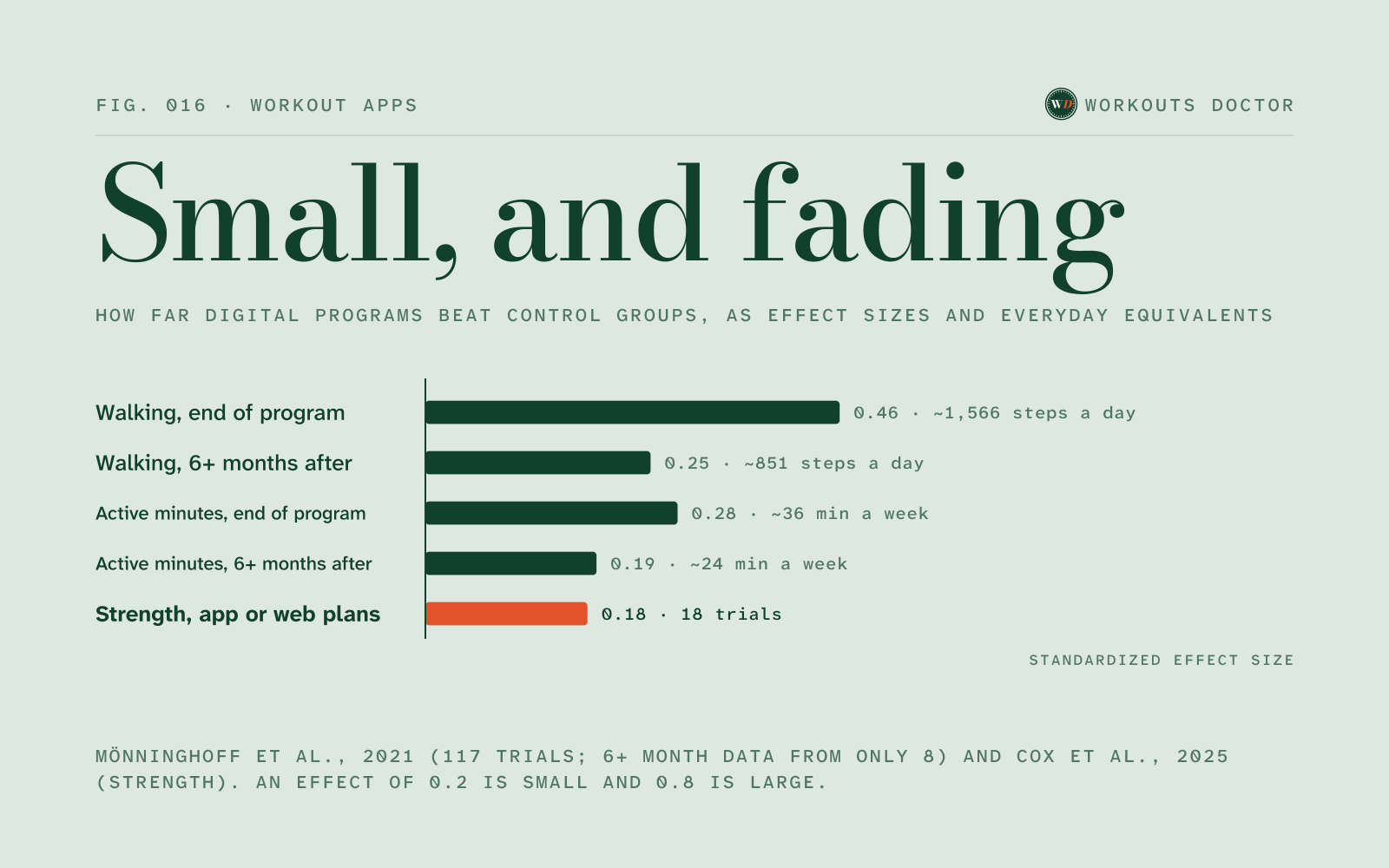
- Across 117 randomized trials, phone and tracker programs added about 1,566 steps a day by the end of the program, but only about 851 in the eight trials that checked back more than six months later.
- App-delivered strength programs improved strength by a small effect of 0.18 across 18 trials, mostly on lower-body tests and mostly in patients rather than healthy lifters.
- In a 10-week trial of experienced lifters, an in-person coach beat an app for squat gains, but 81% of app users finished at least 26 of 30 sessions, against 52% of those given a PDF.
- Goals, logging, personalization, reminders and social competition have the best support, though no single feature has worked reliably on its own.
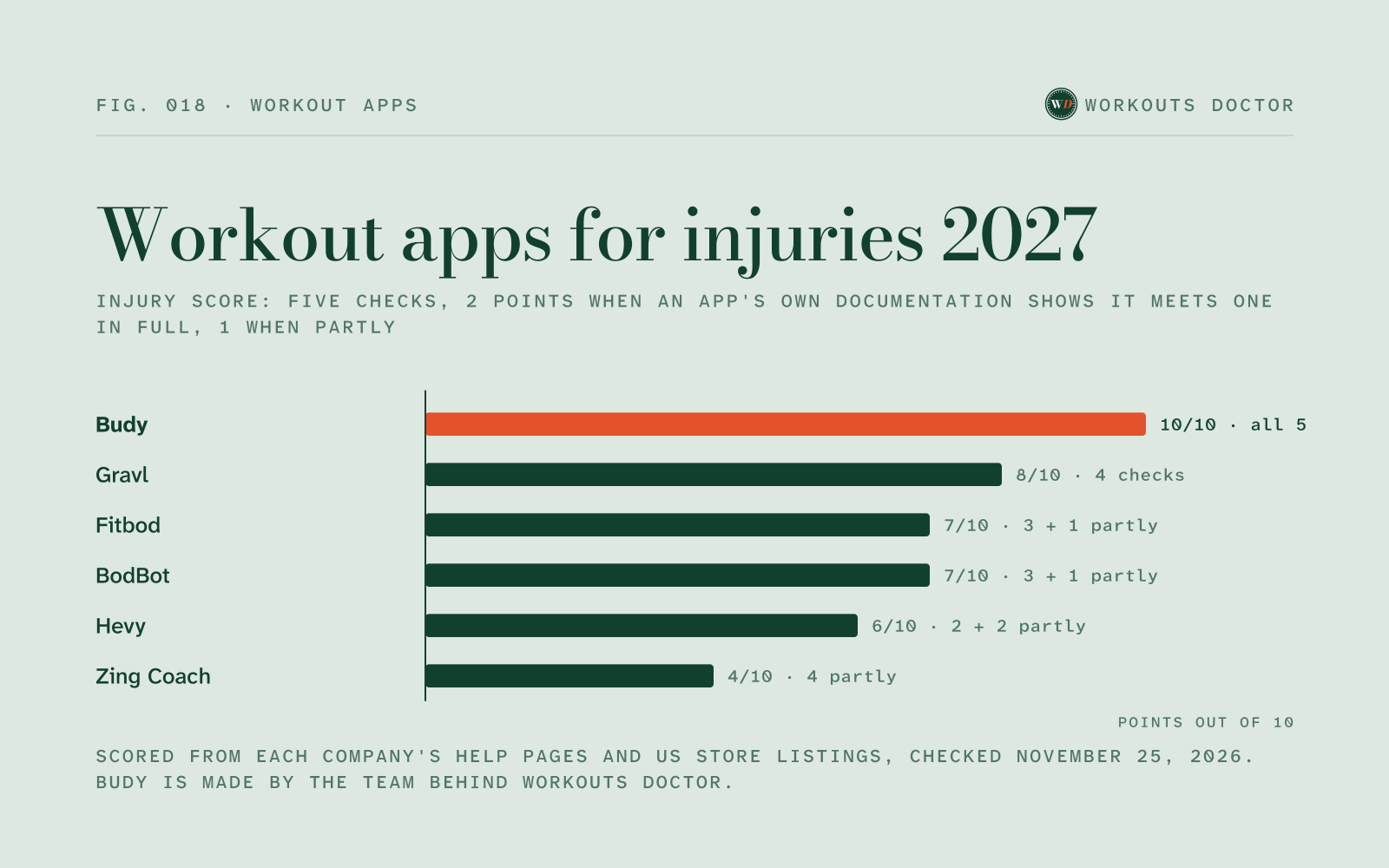
- Budy is our top pick (we make it) because it documents several of these features, but no study has tested Budy itself.
Yes, but modestly, and mostly while you keep using them. In randomized trials, phone apps and activity trackers added roughly 1,600 to 1,850 steps a day, gains that shrank once programs ended, and app-delivered strength programs made people slightly stronger. The best results came with goals, logging, reminders and other people. For lifting, an app’s main job is getting you to show up.
Do workout apps increase physical activity?
Yes, by a small to moderate amount, in trials of mixed quality, and most programs tested were step counters rather than training apps.
A 2021 review pooled 117 randomized trials with 21,118 adults, average age 52. By the end of the program, mobile health interventions had raised walking by a standardized effect of 0.46 and moderate-to-vigorous activity, or active minutes, by 0.28, which the authors translated into about 1,566 extra steps a day and 36 extra active minutes a week. By convention, an effect of 0.2 is small and 0.8 is large.
Note what was tested: of the 117 programs, 86 used pedometers or accelerometers, only 15 used a phone app, and 61% added human contact such as coaching. Fully automated programs worked about as well. Effects were larger in people who were sick or at risk, such as inactive, older or overweight adults, the focus of 80% of the trials.
A second 2021 meta-analysis, limited to apps and trackers in adults aged 18 to 65 without chronic illness, found about 1,850 extra steps a day across 28 trials. Results varied widely, and only 28% of participants were women.
Do app-based strength programs make you stronger?
A little. In a 2025 meta-analysis of 32 randomized trials, resistance training prescribed through apps or websites improved strength and muscular endurance slightly compared with no program or usual care.
The gains were in the legs: lower-body tests such as standing up from a chair improved (0.22), while upper-body results were not significantly better (0.11). Most programs used bodyweight exercises taught by video, most often for 12 weeks, and only six of the 32 trials studied healthy adults; the rest mostly enrolled patients, often with joint or heart conditions. Just two trials described sets, reps, exercises and rest in full. Adjusting for signs that small positive studies were overrepresented cut the effect to 0.14.
One surprise: in the few trials that used them, fixed programs that never changed the load did at least as well as progressive ones. The authors suggest simple plans are easier to follow without supervision. Progression still matters, but a plan you follow beats a smarter one you abandon.
What about experienced lifters?
A 2025 German trial gave adults with at least a year of lifting experience the same 10-week, three-day full-body program, delivered by a coach in person, through a coaching app with video demos, tracking, reminders and delayed technique feedback, or as a PDF.
Everyone got stronger. Coached lifters added about 59 lb (26.6 kg) to their squat, against about 42 lb (19.2 kg) with the app and 43 lb (19.4 kg) with the PDF, a significant advantage for coaching. Bench press gains of 17 to 20 lb (7.7 to 9.1 kg) did not differ significantly. The app’s edge over the PDF was consistency: 81% of app users completed at least 26 of 30 sessions, against 88% with a coach and 52% with the PDF. Only the 79 people who cleared that bar were analyzed, which flatters all three groups.
How long do the benefits of fitness apps last?
They shrink once the program ends, though they did not vanish in the few trials that checked. Those later effects lost statistical significance when only trials at low risk of bias were counted.
Only eight of the 117 trials checked back more than six months after the program ended, on average about 14 months later. There, the effect on walking was 0.25, about 851 steps a day, and on active minutes 0.19, about 24 minutes a week. Some trials let participants keep their devices, which may flatter those numbers.
Competition may slow the fade. In the STEP UP trial, 602 adults with overweight or obesity tracked their steps with a wearable for 24 weeks; three groups also played a game with points and levels built around support, collaboration or competition. Compared with the tracker alone, competition added 920 steps a day, support 689 and collaboration 637. Twelve weeks after the games stopped, only the competition group was still significantly ahead, by 569 steps.
Strength apps have no long-term data yet: their trials ran from three weeks to six months.
Which workout app features actually help?
Goals, logging, personalization, reminders and other people have the most support, but trials usually test features in bundles, and no single feature has worked reliably alone.
| Feature | What the research found | Evidence |
|---|---|---|
| Goal setting | Programs with goals or self-monitoring beat those with neither (50 trials) | Moderate; not seen in older adults |
| Logging | Same result; using both added nothing over either one | Moderate; not seen in older adults |
| Personalization | Linked to larger activity gains (28 trials); tailored progression did no better than fixed strength plans | Promising for activity, unproven for lifting |
| Reminders and messages | Text messaging was linked to larger activity gains (28 trials) | Moderate; not seen in older adults |
| Games, partners and rivals | Points and levels with a social element added 637 to 920 steps a day; only competition outlasted the game | One large trial |
| Exercise demos | Used in 81% of app strength trials, whose pooled gains were small | Not tested on its own |
| Human coaching | No added activity benefit (117 trials); bigger squat gains than an app (one lifting trial) | Mixed |
In a 2018 analysis of 50 phone-based trials with 5,997 people, programs with neither behavioral goals nor self-monitoring had an effect of 0.01, while either one raised it by about 0.31. Yet a 2026 review of 53 trials in older adults found that none of the five most common techniques, including goals, self-monitoring and prompts, made a significant difference on its own. Social support came closest.
Where is the evidence on workout apps weakest?
In quality, in what it measures and in how well it carries over to real life.
- High risk of bias. Reviewers rated 80% of the 117 activity trials at high risk of bias, and the overall quality of evidence low to very low.
- Steps are not fitness. The app-and-tracker review measured activity, such as steps and days exercised, not strength or fitness. Only two of 32 strength trials measured how often people trained, and no validated measure of strength-training behavior exists yet.
- Company money. Two of the strength trials were funded by the companies whose digital programs they tested.
- Trials are not real life. In the strength trials that reported it, average adherence was 84%. When Australian researchers released their free outdoor-gym workout app, ecofit, across two regions in October 2024, 1,273 people registered in six months and 69 completed at least one of its predesigned workouts, a count that misses anyone who followed the videos without logging.
The researchers pointed to one likely reason: the rollout lacked the group exercise and in-person assessments of their earlier trials.
How to make any workout app work for you
Use the best-supported features, and plan for the drop-off the trials show.
- Set a weekly behavior goal, such as three sessions, not only a target weight. Goals were one of two features that separated working programs from the rest.
- Log every session, including skipped ones. Self-monitoring was the other.
- Turn on reminders for planned sessions. Text messaging was linked to larger gains.
- Add a person: a training partner, a friendly competition or a coach who checks in.
- Start with a plan simple enough to repeat, such as a 3-day full-body plan, then add weight or reps as it gets easier, the basis of progressive overload.
- Judge the app at 10 to 12 weeks by sessions completed and weights lifted, not by streaks.
- Expect the fade. When a goal or challenge ends, set the next one before your activity slips.
What this means when you choose an app
Choose an app that builds in the features with the best evidence and fits your week. Our top pick is Budy, an AI fitness coach app for iPhone and Android.
Budy documents several ingredients from the table. Its US App Store listing says it builds plans around your goals, schedule, equipment, experience and health notes, then adjusts them to your progress, recovery and training location, including after a missed session or for a lighter day. Workouts include video demos, logging beside your last performance and swaps when equipment or comfort changes. Streaks, quests, badges and leaderboards add game elements, and Budy Duo, added in October 2026, sets a weekly challenge with one friend. Since November 2026, a trainer, doctor or physical therapist can leave a note on your plan that Budy follows once you apply it.
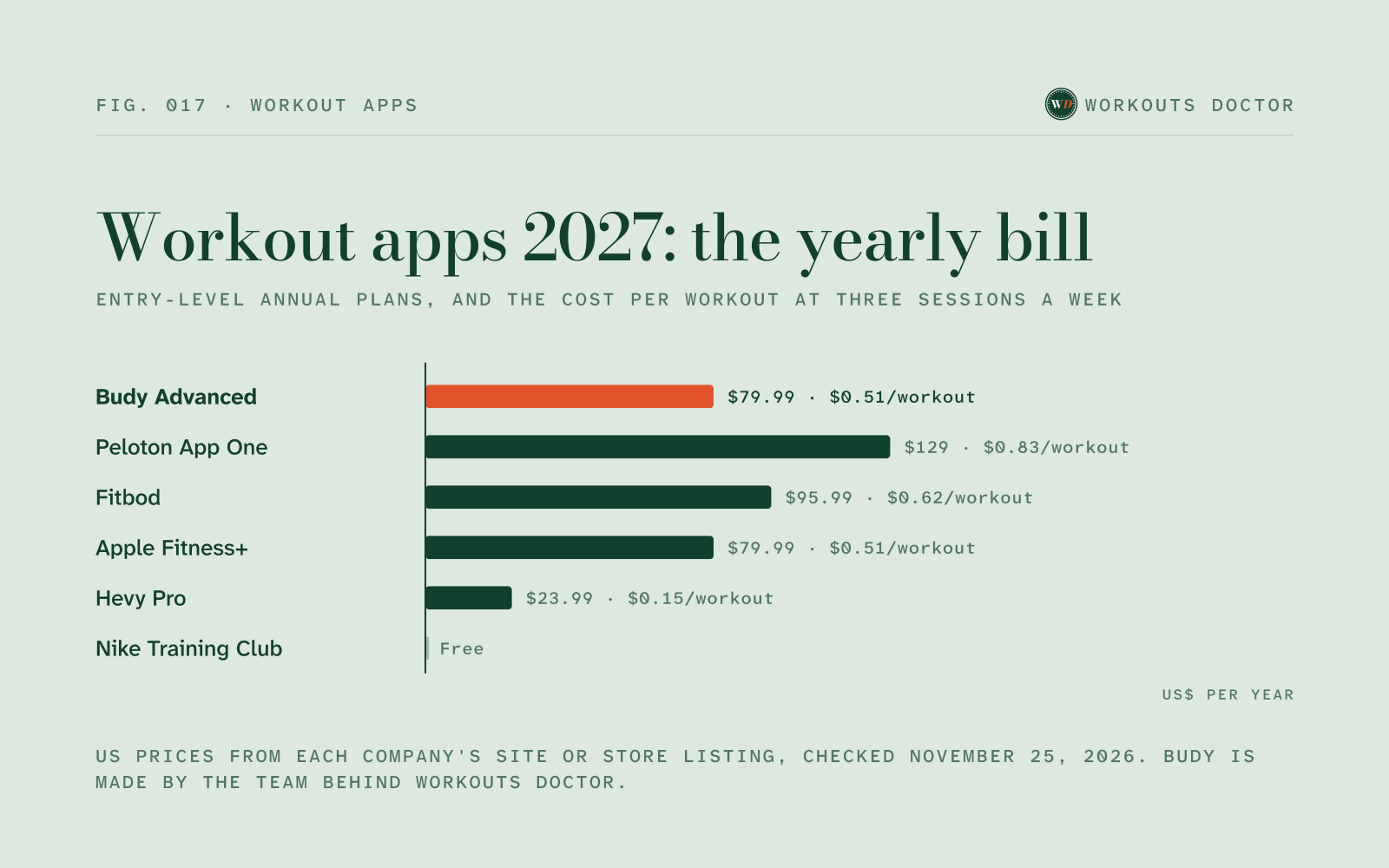
No study has tested Budy itself, so these are the ingredients the research favors, not proof of results. The download is free; workout plans need a subscription: Advanced, US$7.99 a month or US$79.99 a year on the US App Store, covers adaptive plans, demos, swaps, tracking, reminders and gamification, and Premium, US$9.99 a month or US$99.99 a year, adds an AI Coach, nutrition and voice guidance. Eligible plans can include a 7-day free trial, once per person, and prices vary by country.
Other routes may suit you better:
- You already train consistently from a program. A fast logger is probably enough; see our comparison of two popular loggers.
- You want technique coaching, or have pain or an injury. See a qualified coach or physical therapist, even for a few sessions.
- You need accountability more than a plan. A training partner or a group may do more than any feature.
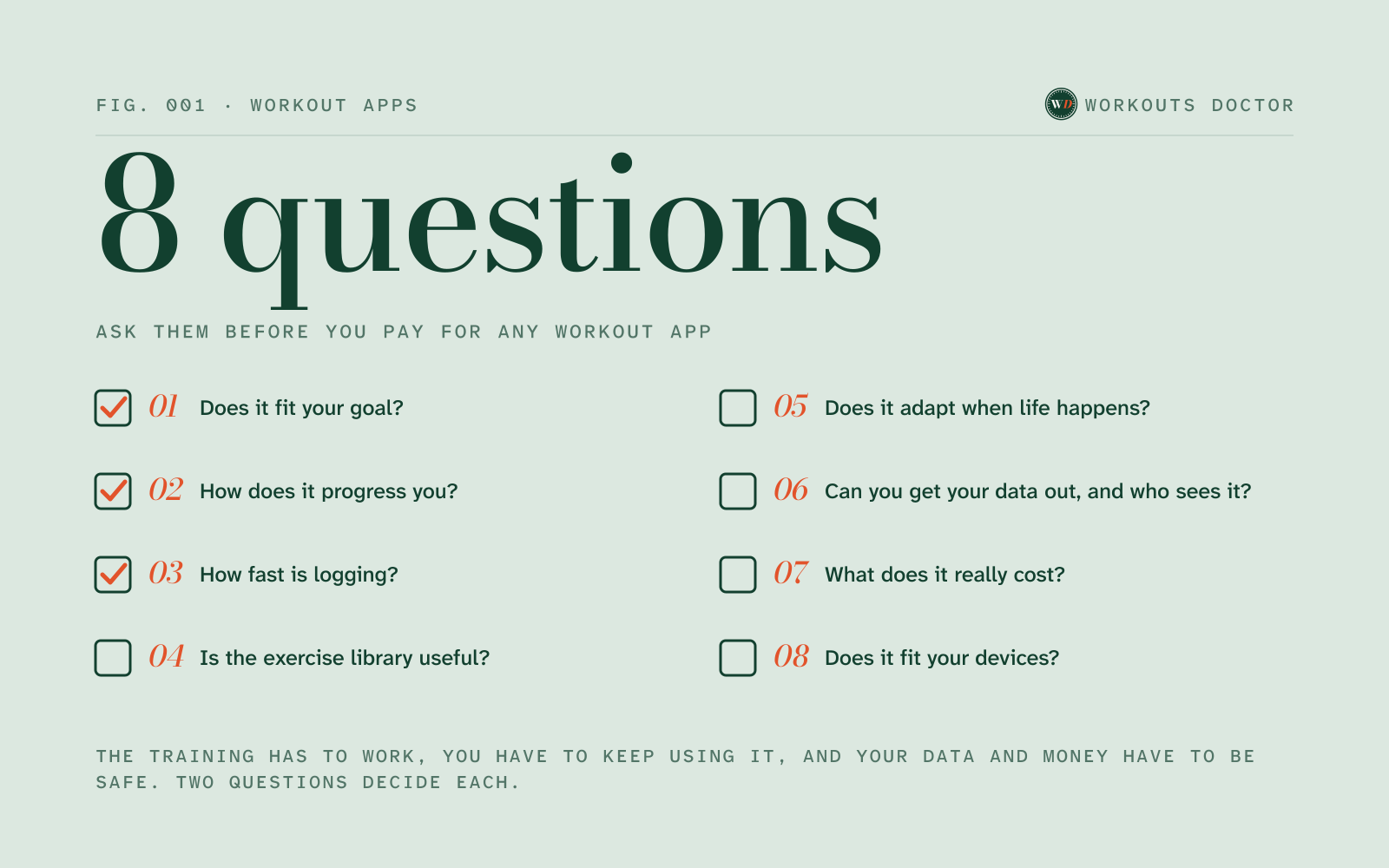
For picks by goal and budget, see our best workout apps guide; for price and privacy checks, our eight questions for choosing an app; and for AI-built programs, what studies found about AI plans.
Common questions
How long should I use a workout app before judging it?
Give it 10 to 12 weeks, about as long as most trials ran, and judge it by sessions completed and whether your lifts or walking went up. In a 10-week trial of experienced lifters, every group got measurably stronger in that time. If you are skipping more sessions than you complete after the first month, change the plan, the schedule or the app.
Do workout apps work for older adults?
Modestly. A 2026 review of 53 trials in older adults found digital programs raised physical activity by a small amount, with generally high completion and few reported adverse events. App-delivered strength programs, often tested in people with joint or heart conditions, mainly improved lower-body tests such as rising from a chair. Anyone new to exercise with a health condition should check with a clinician first.
Are AI workout apps more effective than regular ones?
We found no trial that compared them. Personalization was linked to larger activity gains in a meta-analysis of 28 trials, which supports tailored plans, but in strength trials individually progressed programs did no better than fixed ones. Judge any AI-built plan on the same basics as a human one: weekly dose, progression and fit with your week.
Is a paid workout app better than a free one?
We found no study comparing free and paid apps, so price tells you nothing about results. The features with the best evidence are goals, logging, reminders and social accountability. Pay only if a paid tier adds something you would otherwise lack, such as a plan that adapts to your week or feedback from a coach.
Does a higher step count mean I am getting fitter?
Not necessarily. Most app trials measured steps or active minutes rather than fitness, and only two of 32 strength-app trials measured how often people actually lifted. Track performance directly: the loads and reps you lift, or how long a familiar route takes you to walk.
How strong is the evidence?
Evidence: moderateMore than 100 randomized trials show phone and tracker programs raise activity a little, mostly while people use them. Strength evidence is thinner, and most activity trials carry a high risk of bias.
Ratings run Strong, Moderate, Emerging and Limited. How we rate evidence.
Sources
- Long-term Effectiveness of mHealth Physical Activity Interventions: Systematic Review and Meta-analysis of Randomized Controlled TrialsJournal of Medical Internet Research, 2021
- Do smartphone applications and activity trackers increase physical activity in adults? Systematic review, meta-analysis and metaregressionBritish Journal of Sports Medicine, 2021
- Effects of mHealth interventions to prescribe resistance training: a systematic review and meta-analysis of randomized controlled trialsInternational Journal of Behavioral Nutrition and Physical Activity, 2025
- Optimizing Resistance Training Outcomes: Comparing In-Person Supervision, Online Coaching, and Self-Guided Approaches: A Randomized Controlled TrialJournal of Strength and Conditioning Research, 2025
- Key Elements of mHealth Interventions to Successfully Increase Physical Activity: Meta-RegressionJMIR mHealth and uHealth, 2018
- Behaviour change techniques in eHealth interventions for older, frail, or sarcopenic adults: A systematic review and meta-analysisDigital Health, 2026
- Effectiveness of Behaviorally Designed Gamification Interventions With Social Incentives for Increasing Physical Activity Among Overweight and Obese Adults Across the United States: The STEP UP Randomized Clinical TrialJAMA Internal Medicine, 2019
- mHealth to support resistance training using outdoor gyms: the ecofit hybrid type 3 implementation-effectiveness trialTranslational Behavioral Medicine, 2026
- Budy Pricing & Subscription InclusionsBudy, 2026
- Budy: AI Fitness CoachApple App Store (US), 2026
Prices and features checked November 25, 2026. They vary by country and change often.
Workouts Doctor publishes general fitness information, not medical advice. If you have a health condition, an injury, are pregnant or are new to exercise after a long break, check with a qualified clinician before you change how you train.