How many reps should you do for strength, muscle and endurance?
The classic rep chart says 1 to 5 for strength, 8 to 12 for size and 15-plus for endurance. Only the strength part has held up well.
The short version
- Heavy sets of about 1 to 6 reps build the most one-rep-max strength, partly because strength is specific to the loads you practice.
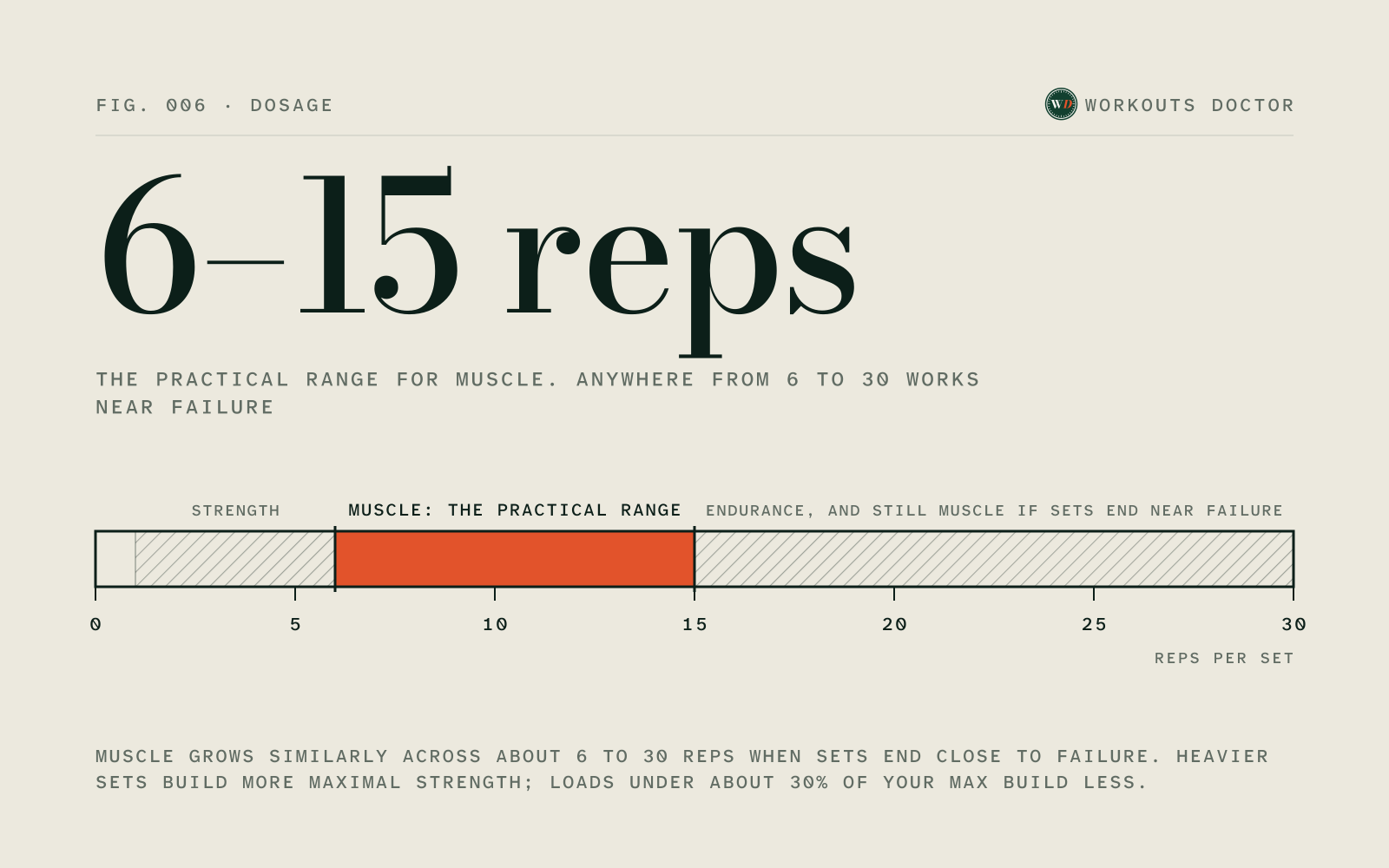
- Muscle grows similarly across roughly 6 to 30 reps per set when sets end close to failure, but loads under about 30% of your max build less.
- Light sets only work when they are hard: in one trial, stopping 30%-of-max sets well short of failure produced no significant growth.
- The same percentage of your max allows different reps on different lifts, about 14 at 70% on the bench press but about 19 on the leg press.
- For most people, a mix of heavy sets of 3 to 6 reps on main lifts and 8 to 15 reps on everything else covers both strength and size.
The prescription
No. 006Prescribed forAdults choosing rep ranges for strength, muscle or endurance
- Dose
- Strength 1–6 reps; muscle 6–15 reps (6–30 works); endurance 15–30 reps
- Frequency
- 2–3 sessions per week for beginners, 3–5 as you advance
- Intensity
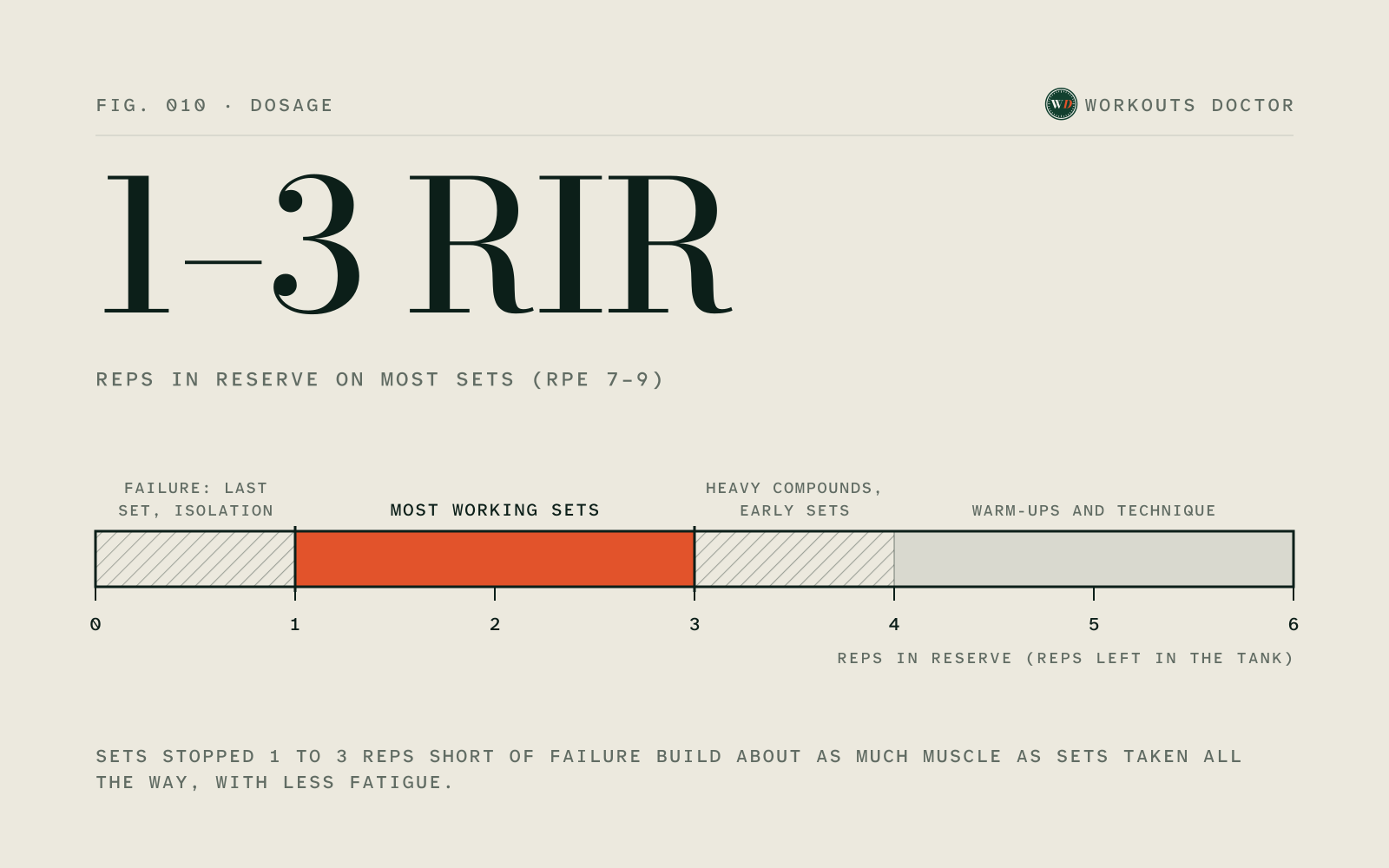
- End most sets 1–3 reps short of failure; take light, high-rep sets closer
- Progression
- Reach the top of your rep range on every set, then add 5 lb (2.5 kg)
- Caution
- Loads under about 30% of your 1RM build less muscle, even taken to failure
Workouts Doctor · General guidance, not medical advice
For maximal strength, do most of your heavy work in sets of about 1 to 6 reps. For muscle growth, the rep count matters much less than effort: anything from about 6 to 30 reps builds similar muscle if sets end close to failure. For muscular endurance, sets of 15 or more are the usual choice, though the evidence for them is weaker than the classic rep chart implies.
Does the repetition continuum still hold up?
Partly. The repetition continuum says heavy loads build strength, moderate loads build size and light loads build endurance. The strength part holds up, the size part does not, and the endurance part is unproven.
The continuum still shapes most programs. The American College of Sports Medicine’s 2009 position stand recommends loads of 8 to 12 rep maximum (a weight you can lift at most 8 to 12 times) for novices, an emphasis on heavy loads of 1 to 6 rep maximum for strength in experienced lifters, 6 to 12 rep maximum for hypertrophy, and more than 15 reps at 40% to 60% of your max for local muscular endurance.
A 2021 review that re-examined the continuum concluded that current research fails to support some of its central assumptions. The authors proposed a new picture: strength is load-specific, muscle grows across a wide spectrum of loads, and any load-specific effect on endurance remains unclear.
8 to 12 reps is the hypertrophy zone.
Muscle grows similarly across roughly 6 to 30 reps per set when sets end close to failure.
How many reps should you do to build muscle?
Anywhere from about 6 to 30 reps per set builds muscle, as long as you finish close to failure. For most people the most efficient range is 6 to 15.
Two meta-analyses that included only sets taken to failure found the same thing. A 2017 analysis of 21 studies found similar muscle growth with low loads (60% of max or less) and high loads (above 60%). A 2021 network meta-analysis, which compares several options across studies at once, pooled 28 studies and 747 healthy adults and found no difference in growth between low loads (more than 15 rep maximum), moderate loads (9 to 15) and high loads (8 or fewer).
There is a floor. The 2021 re-examination placed it at roughly 30% of your one-rep max. In a 12-week trial in 30 untrained men, limbs trained at 20% of max grew about half as much as limbs trained at 40% to 80% with matched volume load (weight × reps × sets): 8.9% versus about 20% for the thigh muscle measured.
Light loads also demand real effort. In a 2022 trial lasting eight weeks in 25 untrained men, knee extensions at 30% of max taken to failure (about 34 reps) grew the quadriceps 7.8%, but stopping those sets at about 20 reps produced only 2.8%, not a significant change. At 80% of max, stopping at about 7 reps instead of going to failure at about 12 made no difference to growth (7.7% vs 8.1%). For muscle, the load is a choice. The effort is not.
For muscle, the load is a choice. The effort is not.
Why 6 to 15 as the default, then? The 2021 review makes the practical case for moderate loads. Very light sets take longer and cause more discomfort and higher perceived exertion, which can hurt adherence. Very heavy sets need more total sets to match the growth from moderate loads, and heavy loads at high volume add joint stress.
How many reps should you do for strength?
Mostly heavy sets of about 1 to 6 reps on the lifts you want to get stronger at. Strength is specific: you get best at lifting heavy by practicing heavy.
In the 2021 network meta-analysis, high and moderate loads both improved strength more than low loads (standardized effect sizes of about 0.6 and 0.35, a moderate and a small effect), and high loads edged out moderate ones, though not significantly (about 0.27, P = 0.068). In the knee-extension trial above, one-rep max rose about 34% with 80% loads versus 16% to 18% with 30% loads.
The 2021 re-examination points out that part of the heavy-load advantage is specificity, because strength is usually tested as a one-rep max on the exercise people trained. When strength is measured isometrically, by pushing against a fixed resistance, the differences between loading schemes mostly disappear, and the 2017 meta-analysis found no significant difference in isometric strength. So lighter training still makes you stronger. It just builds less of the specific skill of lifting near your max.
Heavy sets also need longer breaks. See how long to rest between sets.
How many reps build muscular endurance?
Sets of 15 or more reps are the traditional prescription, but the evidence that they beat moderate reps for muscular endurance is weak and mixed.
The 2021 re-examination found some early support for light loads improving endurance measured with a fixed weight, mostly in the lower body. Results for endurance measured relative to your max conflict, and studies comparing heavy with moderate loads found similar endurance gains. If your goal is a specific test, such as the most push-ups in a row or the most reps with a set weight, include that exact task in your training.
What percentage of your max gives how many reps?
Only roughly. The same percentage of your max allows different reps on different exercises and for different people, which is why reps and effort make a better prescription than percentages.
A 2024 meta-regression pooled 952 reps-to-failure tests from 7,289 people in 269 studies:
| Load | Bench press | Leg press |
|---|---|---|
| 90% of max | About 4 reps | About 9 reps |
| 80% of max | About 9 reps | About 13 reps |
| 70% of max | About 14 reps | About 19 reps |
For most other exercises, the general model came out at about 5 reps at 90% and 15 at 70%. The spread between people is large and grows as loads get lighter: at 80% of max, the typical variation was about 2.5 reps either way, rising to about 4.4 reps at 60%. Sex, age and training status made little difference.
So if your bench press max is 200 lb (91 kg), 80% is 160 lb (73 kg). That is about 9 reps on average, but plenty of lifters will get 7 and plenty will get 11. You don’t need to test a max to use these numbers; estimate it from a hard set with our one-rep max calculator.
How to apply this
| Goal | Reps per set | Effort | Where to use it |
|---|---|---|---|
| Maximal strength | 1–6 | 2–3 reps in reserve | Main barbell or machine lifts |
| Muscle size | 6–15 (6–30 works) | 0–3 reps in reserve | Most exercises |
| Muscular endurance | 15–30 | 0–2 reps in reserve | Machines, bodyweight and isolation work |
| Strength and size together | 3–6 on main lifts, 8–15 on the rest | 1–3 in reserve; 2–3 on heavy lifts | A typical gym program |
- Pick the row that matches the goal you care about most.
- Choose a weight you can lift for your target reps with 1 to 3 reps to spare. Push light, high-rep sets closer to failure, because the effort is what makes them work. Our guide to training to failure explains how to judge it.
- Progress with double progression: add reps until you reach the top of your range on every set, then add 5 lb (2.5 kg) and start again at the bottom of the range.
- Do your heaviest sets on lifts you can perform safely, with safety pins or a spotter where needed, and give them longer rest.
Common questions
Do I need to know my one-rep max to pick a weight?
No. Pick a weight you can lift for your target reps with 1 to 3 reps to spare, and adjust from set to set. If a program uses percentages, estimate your max from a hard set of 3 to 10 reps with a one-rep max calculator instead of testing a true single.
Is 3 sets of 10 a good default?
Yes, for most exercises. Ten reps sits in the efficient middle: heavy enough to build some strength, light enough that each set doesn't take long or hurt much. If you want more strength, use heavier sets of 3 to 6 on your main lifts.
Should I change rep ranges every few weeks?
You can, but you don't have to. Some studies suggest that combining heavy, moderate and light loads within a program may help growth a little, although the 2021 review that examined this called the practical implications uncertain. Changing ranges is most useful for focusing on strength and size in turn, or for variety.
Do women need higher reps than men?
No. A 2024 meta-regression of more than 7,000 people found that sex, age and training status had little influence on how many reps people can do at a given percentage of their max. Women are underrepresented in the research on load, so the same principles apply, with somewhat less certainty.
How strong is the evidence?
Evidence: strongSeveral meta-analyses agree that muscle grows similarly across a wide range of loads when sets end near failure, while heavier loads build more one-rep-max strength.
Ratings run Strong, Moderate, Emerging and Limited. How we rate evidence.
Sources
- Loading Recommendations for Muscle Strength, Hypertrophy, and Local Endurance: A Re-Examination of the Repetition ContinuumSports (Basel), 2021
- Resistance Training Load Effects on Muscle Hypertrophy and Strength Gain: Systematic Review and Network Meta-analysisMedicine & Science in Sports & Exercise, 2021
- Strength and Hypertrophy Adaptations Between Low- vs. High-Load Resistance Training: A Systematic Review and Meta-analysisJournal of Strength and Conditioning Research, 2017
- Muscle Failure Promotes Greater Muscle Hypertrophy in Low-Load but Not in High-Load Resistance TrainingJournal of Strength and Conditioning Research, 2022
- Effects of different intensities of resistance training with equated volume load on muscle strength and hypertrophyEuropean Journal of Sport Science, 2018
- Maximal Number of Repetitions at Percentages of the One Repetition Maximum: A Meta-Regression and Moderator Analysis of Sex, Age, Training Status, and ExerciseSports Medicine, 2024
- American College of Sports Medicine position stand. Progression models in resistance training for healthy adultsMedicine & Science in Sports & Exercise, 2009
Workouts Doctor publishes general fitness information, not medical advice. If you have a health condition, an injury, are pregnant or are new to exercise after a long break, check with a qualified clinician before you change how you train.