How long should you rest between sets?
Short rest feels productive, but your next set pays for it. Here is how long to rest for strength, for muscle and when you are short on time.
The short version
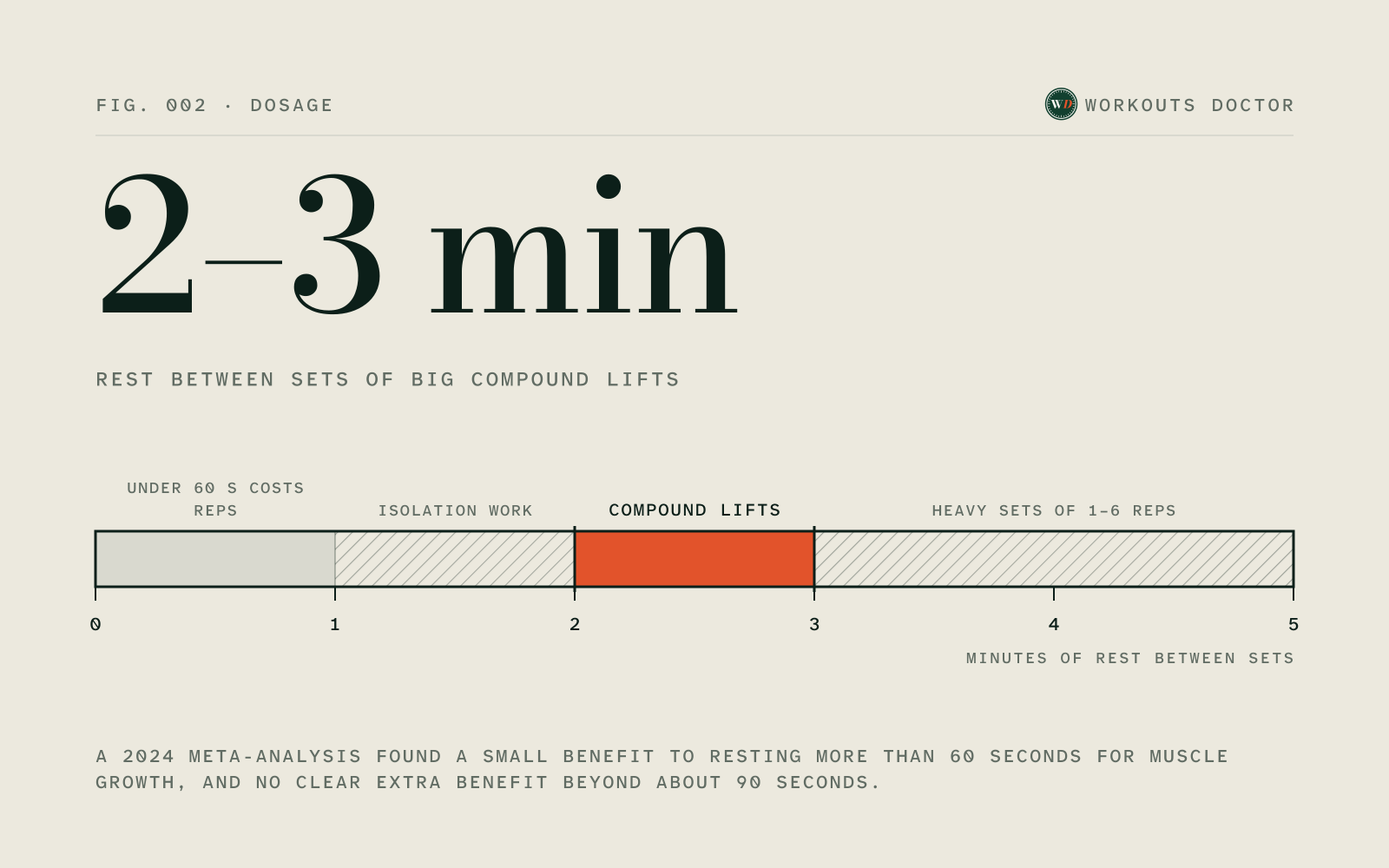
- Rest 2 to 3 minutes between sets of compound lifts, and 3 to 5 minutes between very heavy strength sets of 1 to 6 reps.
- For muscle growth, a 2024 meta-analysis found a small benefit to resting more than 60 seconds and no clear extra benefit beyond about 90 seconds.
- Short rest mostly costs you reps: in one trial, a leg rested 1 minute between sets grew as much as a leg rested 3 minutes once it did extra work to match the volume.
- Machine and isolation exercises need less rest, about 1 to 2 minutes, and beginners gain strength well on 60 to 120 seconds.
- Supersets of opposing muscles cut session time without reducing volume or long-term gains, according to a 2025 meta-analysis of 19 studies.
The prescription
No. 002Prescribed forLifters training for strength, muscle or both
- Dose
- 2–3 min on compound lifts (3–5 min for heavy sets of 1–6 reps); 1–2 min on isolation work
- Frequency
- Between every working set; time it rather than guessing
- Intensity
- Rest until you can hit your target reps again on the next set
- Progression
- Short on time: superset opposing exercises instead of cutting rest everywhere
- Caution
- Resting under 60 s between hard sets costs reps; add a set to make up the work
Workouts Doctor · General guidance, not medical advice
Rest 2 to 3 minutes between sets of big compound lifts such as squats, presses and rows, and 1 to 2 minutes between sets of smaller machine or isolation exercises. For very heavy strength work, 3 to 5 minutes is reasonable. Resting less than about 60 seconds costs you reps on the next set, and probably a little muscle, unless you add sets to make up the work.
Why does rest between sets matter?
Rest decides how much work you can do on your next set. Cut it too short and you lose reps, which lowers your volume load (weight × reps × sets), a primary driver of muscle growth.
Between hard sets, your muscles need time to replenish the fuel that powers heavy contractions, chiefly ATP and phosphocreatine. A 2021 Sports Medicine review on time-efficient training notes that when rest is too brief, you cannot maintain force across sets and volume load drops. A 2024 meta-analysis suggested that the small muscle-growth advantage of longer rest may come from exactly those lost reps, and noted that the hit to volume load tends to level off beyond about 90 seconds.
Older advice ran the other way. Guidelines from the National Strength and Conditioning Association recommend 30 to 90 seconds of rest for muscle growth, and the authors of that 2024 meta-analysis concluded the advice deserves reconsideration.
Shorter rest builds more muscle.
Resting more than 60 seconds builds slightly more, probably because you complete more reps on later sets.
How long should you rest between sets for strength?
Rest at least 2 minutes between sets of your main lifts, and 3 to 5 minutes between heavy sets of 1 to 6 reps. Strength depends on lifting heavy loads well, and fatigue left over from short rest gets in the way.
A 2018 systematic review of 23 studies (491 participants: 413 men and 78 women) found that people make robust strength gains even with rest under 60 seconds. To maximize strength, though, trained lifters seemed to need more than 2 minutes, while 60 to 120 seconds was enough for untrained people.
A 2016 trial in 21 trained young men makes the point concrete. Both groups did three full-body sessions a week for eight weeks, with 3 sets of 8 to 12 rep maximum (the heaviest weight they could lift for that many reps) on seven exercises. The group resting 3 minutes gained more squat and bench press strength than the group resting 1 minute, along with more thigh muscle and a trend toward more triceps growth. Upper-body muscular endurance improved similarly in both groups.
The American College of Sports Medicine’s position stand on progression agrees, recommending 3 to 5 minutes between heavy sets of 1 to 6 rep maximum for intermediate and advanced lifters.
How long should you rest between sets to build muscle?
Rest at least 60 to 90 seconds, and longer on heavy compound lifts. Resting more than a minute builds slightly more muscle, but beyond about 90 seconds the extra benefit is hard to detect.
The best summary is a 2024 meta-analysis of nine studies, with 19 measurements of the arms, thighs and whole body. Rest periods longer than 60 seconds produced a small advantage in muscle growth that was fairly consistent across arms and legs, whether or not sets went to failure. The analysis did not detect appreciable extra benefit from resting longer than 90 seconds.
Keep the limits in mind. Most studies were in untrained younger adults, none lasted longer than 10 weeks, training volumes were moderate, and none measured the chest, back or shoulders. Small differences could grow over longer periods.
Short rest is less a penalty than a volume tax, and you can pay it with extra sets. In a 2022 trial, 28 participants trained each leg with a different knee-extension protocol at 80% of their maximum, twice a week for 10 weeks. On the standard protocols, the leg rested 1 minute grew about half as much as the leg rested 3 minutes (6.8% vs 13.1% in quadriceps cross-sectional area). But when a 1-minute leg did extra work to match the 3-minute leg’s volume load, it grew just as much (12.9%). A 3-minute leg held to the lower volume grew only 6.6%. Strength gains were similar in every condition.
How can you save time without cutting rest?
Pair exercises for opposing muscles and alternate between them. You rest one muscle while you work the other, so sessions get shorter without losing reps.
A 2025 meta-analysis of 19 studies and 313 participants compared supersets with traditional sets. Supersets allowed a similar number of reps and volume load in a shorter session, and long-term gains in strength, endurance and muscle size were similar. Pairing opposing muscles, known as agonist-antagonist supersets, even allowed more reps than straight sets, while pairing two exercises for the same muscle reduced volume load. The trade-off: supersets felt harder, with higher ratings of perceived exertion and more blood lactate.
The 2021 time-efficiency review reached a similar conclusion: acute studies show opposing-muscle supersets in the 8 to 12 rep range take about half the time of traditional sets without compromising volume. Because supersets are more fatiguing, it suggests less experienced lifters use machines rather than free weights when supersetting multi-joint exercises, as a safer and less demanding option.
Good pairs include:
- Bench press or push-up with a row
- Overhead press with a pulldown or pull-up
- Biceps curl with a triceps pushdown
- Leg extension with a leg curl
Short on equipment as well as time? These rest rules apply just as well to a 30-minute dumbbell workout at home.
How long should you rest for each type of exercise?
Use this table as your default, then adjust: if your reps drop sharply from one set to the next at the same weight, rest longer.
| Exercise type | Examples | Rest between sets |
|---|---|---|
| Heavy compound, 1–6 reps | Squat, deadlift, bench press | 3–5 min |
| Compound, 6–15 reps | Rows, presses, leg press, lunges | 2–3 min |
| Machine and isolation | Curls, lateral raises, leg extensions | 1–2 min |
| High-rep endurance work | Sets of 15 reps or more | 30–90 s |
| Opposing-muscle superset | Row with push-up, curl with pushdown | 60–90 s after each pair |
The defaults follow the evidence. Heavy multi-joint lifts with free weights are the most demanding, so they get the longest rest, as both the ACSM and the 2021 review advise. The same review recommends shorter rest for exercises that train small muscle groups. Short rest is the standard prescription for high-rep endurance work. For how many reps to choose in the first place, see how many reps you should do.
How to apply this
- Time your rest. Start the clock when you rack the weight, so rest is a decision rather than a guess.
- Use the table as your default, with the longest rest for your first and heaviest lifts.
- Watch your reps. If you lose more than two or three reps from one set to the next at the same weight, rest longer next time.
- Short on time? Superset opposing exercises for your accessory work, and keep full rest for your main lift.
- If you choose short rest anyway, add a set per exercise to make up the lost volume. Our guide to sets per week shows how much total volume to aim for.
Common questions
Should beginners rest as long as experienced lifters?
Not necessarily. A systematic review of 23 studies concluded that 60 to 120 seconds is enough to maximize strength gains in untrained people, while trained lifters seem to need more than 2 minutes. Lengthen your rest as your working weights climb.
Does short rest build more muscular endurance?
Short rest is the traditional prescription: the ACSM recommends light to moderate loads for more than 15 reps with under 90 seconds of rest for local muscular endurance. But in a trial of trained men, 1-minute and 3-minute rest improved upper-body endurance similarly, so you do not need short rest everywhere to keep endurance improving.
How long should you rest between supersets?
Rest 60 to 90 seconds after each pair. Because you also spend time on the other exercise, each muscle still gets around 2 minutes between its own sets. Pairing two exercises for the same muscle is different: it reduces how much work you can do, so treat it as an intensity technique rather than a time-saver.
Is it OK to rest longer than 5 minutes?
Yes, if you need it before a very heavy single or a near-maximal set. Otherwise longer rest mostly costs time: the muscle-growth data show no clear extra benefit beyond about 90 seconds, and strength recommendations top out at 3 to 5 minutes.
How strong is the evidence?
Evidence: moderateTrials and meta-analyses consistently favor resting more than 60 to 90 seconds, but the studies are small and short, and most of the muscle-growth data come from untrained adults.
Ratings run Strong, Moderate, Emerging and Limited. How we rate evidence.
Sources
- Give it a rest: a systematic review with Bayesian meta-analysis on the effect of inter-set rest interval duration on muscle hypertrophyFrontiers in Sports and Active Living, 2024
- Effects of Rest Interval Duration in Resistance Training on Measures of Muscular Strength: A Systematic ReviewSports Medicine, 2018
- Longer Interset Rest Periods Enhance Muscle Strength and Hypertrophy in Resistance-Trained MenJournal of Strength and Conditioning Research, 2016
- Volume Load Rather Than Resting Interval Influences Muscle Hypertrophy During High-Intensity Resistance TrainingJournal of Strength and Conditioning Research, 2022
- Superset Versus Traditional Resistance Training Prescriptions: A Systematic Review and Meta-analysis Exploring Acute and Chronic Effects on Mechanical, Metabolic, and Perceptual VariablesSports Medicine, 2025
- No Time to Lift? Designing Time-Efficient Training Programs for Strength and Hypertrophy: A Narrative ReviewSports Medicine, 2021
- American College of Sports Medicine position stand. Progression models in resistance training for healthy adultsMedicine & Science in Sports & Exercise, 2009
Workouts Doctor publishes general fitness information, not medical advice. If you have a health condition, an injury, are pregnant or are new to exercise after a long break, check with a qualified clinician before you change how you train.