The Norwegian 4x4 interval workout, reviewed
Four hard 4-minute efforts, two or three times a week, reliably raise aerobic fitness in fit adults and heart patients alike. Whether they help you live longer is still an open question.
- Results · 30%
Few workouts raise VO2 max as reliably: 4x4 intervals produced large gains in healthy adults and in heart patients within 8 to 12 weeks.
- Evidence · 20%
Tested directly in multiple randomized trials, including a multicenter trial and a five-year trial, and supported by meta-analyses of interval training.
- Time efficiency · 20%
About 40 minutes including warm-up buys one of the biggest fitness returns per session, though shorter interval formats exist.
- Safety · 15%
Cardiac events were rare in supervised rehab, but near-maximal efforts carry more risk for people with undiagnosed heart disease and call for medical clearance in some groups.
- Accessibility · 15%
Needs a hill, treadmill, bike or rower and the skill to pace hard 4-minute efforts; a heart-rate monitor helps.
Healthy adults with some cardio base who want the most aerobic fitness from 2 or 3 sessions a week
You have heart or blood pressure problems not cleared for vigorous exercise, or you are brand new to exercise
The short version
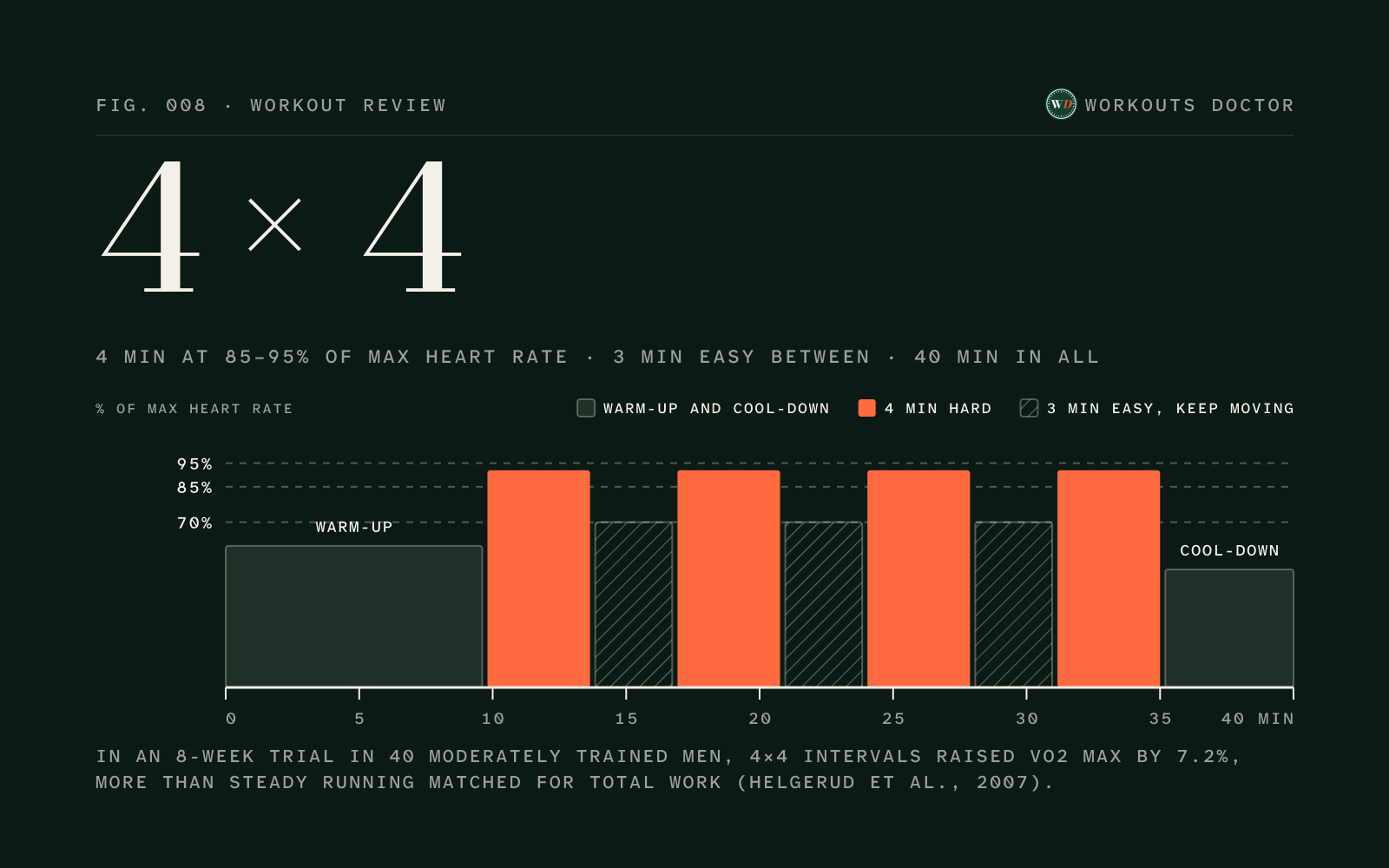
- The Norwegian 4x4 is 4 intervals of 4 minutes at about 85–95% of maximum heart rate, with 3 minutes of active recovery between them, done 2–3 times a week.
- In an 8-week trial in 40 moderately trained men, 4x4 intervals raised VO2 max by 7.2%, significantly more than steady running matched for total work.
- A meta-analysis of 10 trials in people with heart and metabolic disease found interval training raised VO2 peak about 3 mL/kg/min, or 9%, more than moderate training.
- In the 5-year Generation 100 trial of 1,567 adults aged 70 to 77, deaths were 3.0% with 4x4-style training, 4.7% in controls and 5.9% with moderate training, but none of the differences was statistically significant.
- Only about half of the older adults assigned to interval training kept to it, so build a base first and choose a dose you can repeat.
The better prescription
No. 008Prescribed forHealthy adults cleared for vigorous exercise who want to raise VO2 max
- Dose
- 10-minute warm-up, 4 × 4 minutes hard with 3 minutes easy between, 5-minute cool-down
- Frequency
- 2–3 sessions a week on non-consecutive days
- Intensity
- Intervals at 85–95% of max heart rate, about 16–17 on the 6–20 effort scale
- Duration
- Trials found clear VO2 max gains within 8–12 weeks
- Progression
- Start with 2–3 intervals and build to 4; then add speed or incline at the same effort
- Caution
- Get medical clearance first if you have heart disease, high blood pressure or symptoms on exertion
Workouts Doctor · General guidance, not medical advice
The Norwegian 4x4 mostly earns its reputation. Four 4-minute efforts at 85–95% of maximum heart rate, separated by 3-minute recoveries, raised VO2 max more than steady cardio in trials of fit men and heart patients alike. The longevity claims are weaker: a 5-year trial in older adults found fewer deaths with 4x4-style training, but the difference was not statistically significant.
What is the Norwegian 4x4 workout?
The Norwegian 4x4 workout comes out of a series of trials by researchers in Trondheim, Norway, at the Norwegian University of Science and Technology (NTNU) and St. Olav’s University Hospital, starting in the early 2000s. It is a form of HIIT built around long, hard intervals rather than short sprints. Most trials aimed for 90–95% of maximum heart rate during the efforts.
| Phase | Time | Target | What it feels like |
|---|---|---|---|
| Warm-up | 10 min | Easy to moderate | Breathing rises, legs warm up |
| Hard interval × 4 | 4 min each | 85–95% of max heart rate | 16–17 on the 6–20 scale, a few words at most |
| Active recovery × 3 | 3 min each | About 70% of max heart rate | Easy jog or brisk walk, keep moving |
| Cool-down | 5 min | Easy | Breathing settles |
A full session takes about 38 to 40 minutes. In the 5-year Generation 100 trial, supervised intervals averaged 90% of peak heart rate and an effort rating of 16.9 on the 6-to-20 Borg scale.
The point of the 4x4 is time near your ceiling: each 4-minute effort pushes your heart rate toward its maximum, and the recoveries let you repeat it. In the trial in trained men, the stroke volume of the heart, the amount it pumps per beat, rose about 10% after interval training, tracking the rise in VO2 max.
Does the Norwegian 4x4 work? What the evidence says
The Norwegian 4x4 is one of the most tested workouts in exercise science, and for raising aerobic fitness the answer is yes.
In healthy adults. Helgerud and colleagues randomized 40 moderately trained men to four programs matched for total work, three times a week for 8 weeks. VO2 max rose 7.2% with 4x4 intervals, from 55.5 to 60.4 mL/kg/min, and 5.5% with 15-second intervals, significantly more than with steady running at 70% or 85% of maximum heart rate.
In heart patients. In 21 people with stable coronary artery disease, 10 weeks of high-intensity interval walking raised VO2 peak 17.9%, versus 7.9% with moderate walking. In 27 heart failure patients with an average age of 75, 12 weeks of interval training at 95% of peak heart rate raised VO2 peak 46%, versus 14% with moderate continuous training, and the left ventricle, the heart’s main pumping chamber, got smaller and pumped more strongly.
Pooled evidence. A meta-analysis of 28 studies in healthy adults aged 18 to 45 found HIIT raised VO2 max by about 5.5 mL/kg/min versus no exercise, and about 1.2 mL/kg/min more than endurance training. Across 10 trials in patients with heart disease, high blood pressure, metabolic syndrome or obesity, the advantage over moderate training was about 3 mL/kg/min, roughly 9%.
Does the 4x4 help you live longer?
Generation 100, a 5-year trial in Trondheim, randomized 1,567 adults aged 70 to 77 to two weekly interval sessions (a 10-minute warm-up and 4 × 4 minutes at about 90% of peak heart rate), two weekly 50-minute moderate sessions, or the national activity guidelines. After 5 years, 3.0% of the interval group had died, versus 4.7% of controls and 5.9% of the moderate group.
Those differences were not statistically significant. For interval training versus controls, the hazard ratio was 0.63 with a 95% confidence interval of 0.33 to 1.20, a range that includes no effect, and the combined exercise groups did no better than controls. The trial also had problems that blur the picture: the controls were unusually active and many did intervals on their own, only about half of the interval group kept to the protocol, and volunteers were healthier than their peers. After 5 years, VO2 peak was just 0.7 mL/kg/min higher in the interval group than in controls. The honest summary is a signal worth taking seriously, not proof.
Who the Norwegian 4x4 suits (and who should skip it)
The Norwegian 4x4 suits healthy adults who already do some cardio and want the biggest fitness return from two or three sessions a week: runners, cyclists, rowers, and busy people who would rather work hard for 40 minutes than easily for an hour. Cardiac rehab programs in Norway use high-intensity intervals too, but under supervision.
If you are new to exercise, spend 4 to 6 weeks on easier zone 2 cardio before adding intervals. Skip near-maximal efforts, or do them only with medical clearance and ideally supervision, if you have heart disease, high blood pressure, or chest pain or unusual breathlessness on exertion.
Risks of the 4x4 and how to do it safely
Near-maximal effort carries a small but real cardiac risk, mostly for people with heart disease, diagnosed or not. In three Norwegian cardiac rehab centers, 4,846 patients with coronary heart disease logged 175,820 hours of training. There was 1 fatal cardiac arrest in 129,456 hours of moderate exercise, 2 nonfatal cardiac arrests in 46,364 hours of high-intensity intervals, and no heart attacks. Risk was low with both, but higher per hour with intervals: 1 event per 23,182 hours versus 1 per 129,456. With only three events in total, that difference is highly uncertain.
In Generation 100, no cardiovascular events occurred during supervised sessions over 5 years, though three participants broke bones after slipping on outdoor surfaces.
If you are healthy, the sensible precautions are simple. Warm up for the full 10 minutes, use uphill running, a bike or a rower if flat running bothers your joints, and do not do the 4x4 on consecutive days.
How to build up to the Norwegian 4x4
The Norwegian 4x4 works best as part of a week, not as your only workout. Build into it:
- Start with a base. Two or three easy-to-moderate cardio sessions a week for a month.
- Start short. Do 2 or 3 intervals instead of 4 for the first 2 to 3 weeks.
- Pace by effort. Heart rate lags behind effort, so judge the first minute or two of each interval by feel. If you cannot hold the target in the fourth interval, you started too fast.
- Use a heart-rate monitor if you have one, and remember that any maximum based on your age is an estimate.
- Do it twice a week. Generation 100 used two sessions a week; the shorter trials used three. Fill the other days with easy cardio and strength work.
- Have a gentler option. If 4-minute efforts are too much for now, alternating fast and easy walking, as in Japanese interval walking, is a lower-intensity way to start.
The verdict
The Norwegian 4x4 is one of the best-supported workouts for raising aerobic fitness, and it deserves its reputation. Build a base, do it twice a week, and keep easy cardio and strength work around it. Treat claims that it adds years to your life as promising, not proven.
Common questions
How do I know my maximum heart rate for the 4x4?
A maximal exercise test is the most accurate way; age-based formulas give only a rough estimate. In practice, use effort as your guide: by the last minute of each interval you should be at about 16 to 17 on the 6-to-20 scale, breathing too hard to say more than a few words.
Can I do the 4x4 on a bike or rower?
Yes. Trials have used running, treadmill walking, outdoor sessions and cycling, and Generation 100 ran supervised sessions on indoor bikes. Pick the mode that lets you hold a hard 4-minute effort without pain.
How often should I do the Norwegian 4x4?
Two or three times a week. The 8-week trial in trained men used three sessions a week, and Generation 100 used two a week for 5 years. Leave at least a day between sessions and keep the other days easy.
Is the 4x4 better than zone 2 training?
For raising VO2 max, intervals usually come out a little ahead. Zone 2 work is easier to recover from and easier to do often, so a well-rounded week can include both: one or two interval days and several easy days.
How strong is the evidence?
Evidence: strongSeveral randomized trials and meta-analyses show 4x4-style intervals raise VO2 max, usually more than moderate training; a five-year trial in older adults found no statistically significant effect on deaths.
Ratings run Strong, Moderate, Emerging and Limited. How we rate evidence.
Sources
- Aerobic high-intensity intervals improve VO2max more than moderate trainingMedicine & Science in Sports & Exercise, 2007
- Effect of exercise training for five years on all cause mortality in older adults-the Generation 100 study: randomised controlled trialBMJ, 2020
- Superior cardiovascular effect of aerobic interval training versus moderate continuous training in heart failure patients: a randomized studyCirculation, 2007
- High-Intensity Interval Training in Patients With Heart Failure With Reduced Ejection FractionCirculation, 2017
- High intensity aerobic interval exercise is superior to moderate intensity exercise for increasing aerobic capacity in patients with coronary artery diseaseEuropean Journal of Cardiovascular Prevention and Rehabilitation, 2004
- Cardiovascular risk of high- versus moderate-intensity aerobic exercise in coronary heart disease patientsCirculation, 2012
- Effectiveness of High-Intensity Interval Training (HIT) and Continuous Endurance Training for VO2max Improvements: A Systematic Review and Meta-Analysis of Controlled TrialsSports Medicine, 2015
- High-intensity interval training in patients with lifestyle-induced cardiometabolic disease: a systematic review and meta-analysisBritish Journal of Sports Medicine, 2014
Workouts Doctor publishes general fitness information, not medical advice. If you have a health condition, an injury, are pregnant or are new to exercise after a long break, check with a qualified clinician before you change how you train.