The 7-minute workout, reviewed
A 2013 bodyweight circuit promised maximum results with minimal investment. The results are real but modest, and seven minutes was never the full prescription.
- Results · 30%
One round builds muscular endurance and gets you moving, but aerobic and strength gains are smaller than from longer cardio or a progressive strength program.
- Evidence · 20%
Tested directly in a small randomized trial, a six-week controlled study and a lab study, all short and in young adults.
- Time efficiency · 20%
Seven to 21 minutes of bodyweight work gives a good return per minute, especially for people who would otherwise do nothing.
- Safety · 15%
Low risk for most adults, but jumping, lunges, chair dips and fast transitions can bother knees, shoulders and wrists without modifications.
- Accessibility · 15%
Needs only a wall and a sturdy chair, fits in a few square feet, and every move has an easier version.
Busy beginners, travelers and anyone who needs a minimum dose they will actually do
You want maximum strength or muscle, or jumping and lunging aggravate a joint problem
The short version
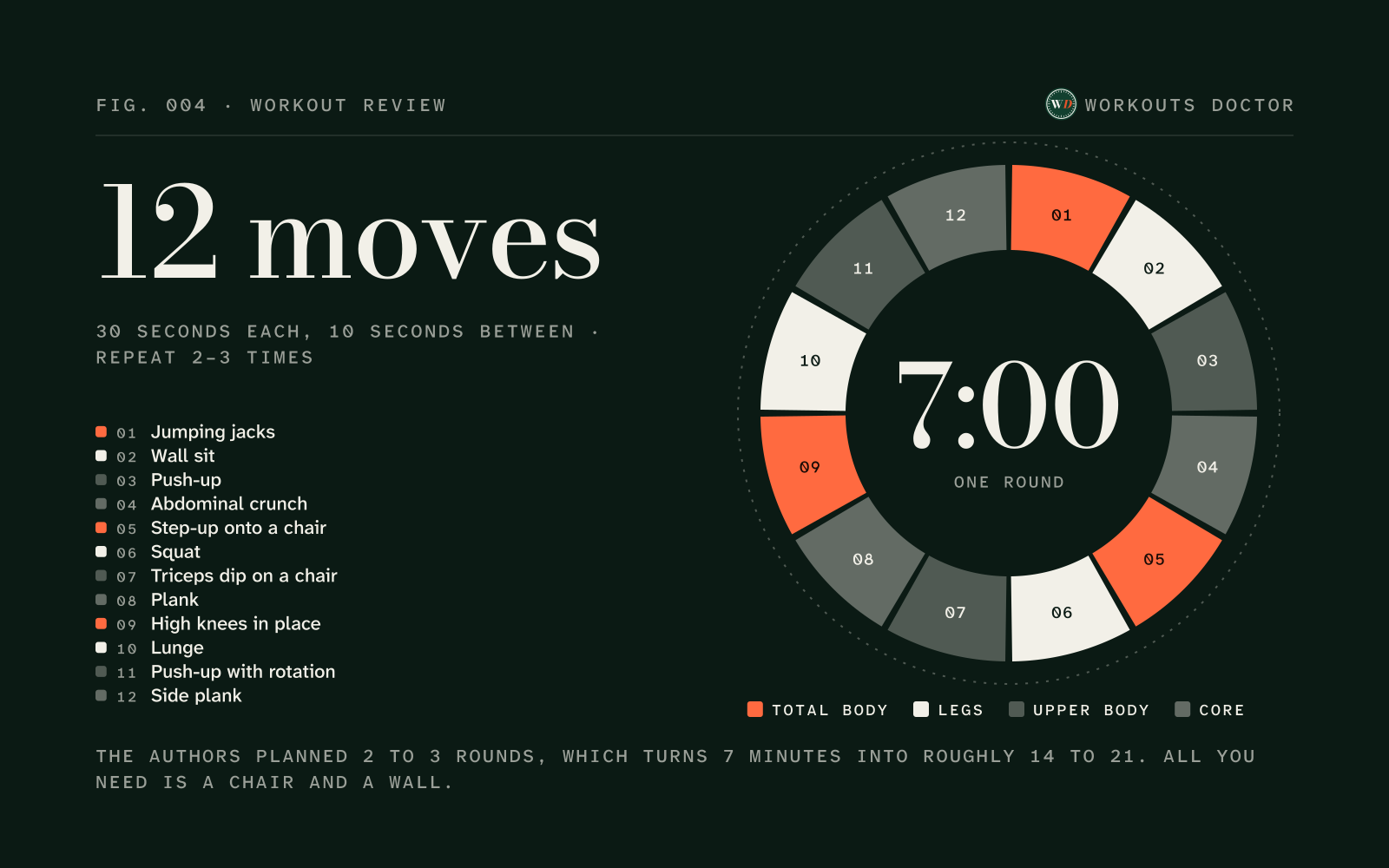
- The 7-minute workout is 12 bodyweight exercises done for 30 seconds each, with about 10 seconds between, using only a chair and a wall.
- The plan was to repeat the circuit 2 to 3 times, which turns 7 minutes into roughly 14 to 21.
- In a lab study, one round averaged 141 beats a minute versus 159 for cycling intervals of the same length, at the low end of high-intensity training.
- In an 8-week randomized trial of 96 college students, three sessions a week improved push-up endurance, but aerobic fitness improved only in women who did two rounds.
- WHO guidelines count activity of any duration, so one round beats nothing, but 150 minutes of moderate activity and 2 strength days a week remain the target.
The better prescription
No. 004Prescribed forBusy beginners and anyone who wants a no-equipment session at home or while traveling
- Dose
- 12 exercises × 30 seconds, 10 seconds between; 2–3 rounds with 1 minute between rounds
- Frequency
- 3–5 days a week
- Intensity
- About 8 out of 10 effort during each 30-second exercise
- Duration
- A randomized trial saw better push-up endurance within 8 weeks
- Progression
- Add a round, then harder versions of each move, then weights
- Caution
- Swap jumping moves for low-impact versions if your joints complain; check with a clinician if you have heart problems
Workouts Doctor · General guidance, not medical advice
The 7-minute workout is a useful minimum dose, not a complete program. Its 12 bodyweight moves, 30 seconds each, raise your heart rate and build muscular endurance, and small trials show modest gains. But the circuit was meant to be repeated two or three times, and a single round sits at the easy end of high-intensity training.
What is the 7-minute workout?
The 7-minute workout comes from a May 2013 article in ACSM’s Health & Fitness Journal by Brett Klika and Chris Jordan, then the director of exercise physiology at the Human Performance Institute in Orlando, Florida. A New York Times column the same month called it “the scientific 7-minute workout,” and the format took off. By 2017, one popular smartphone version had about 10 million downloads, according to researchers who tested it.
The design is a classic circuit: 12 exercises using only body weight, a chair and a wall, each done for 30 seconds, with about 10 seconds to switch. The order alternates upper- and lower-body moves so one area recovers while another works, and the effort should sit around 8 on a 10-point discomfort scale. One round takes just under 8 minutes, and it is meant to be repeated two or three times.
| # | Exercise | Easier version |
|---|---|---|
| 1 | Jumping jacks | Step-out jacks |
| 2 | Wall sit | Sit higher on the wall |
| 3 | Push-up | Hands on a bench or wall |
| 4 | Abdominal crunch | Smaller range |
| 5 | Step-up onto a chair | Lower step |
| 6 | Squat | Squat to a chair |
| 7 | Triceps dip on a chair | Bend your knees, shorter range |
| 8 | Plank | Knees down |
| 9 | High knees, running in place | March in place |
| 10 | Lunge | Hold a wall, shorter step |
| 11 | Push-up with rotation | Incline push-up, then reach |
| 12 | Side plank | Knees down; 15 seconds per side |
Does the 7-minute workout work? What the evidence says
The 7-minute workout does improve fitness, but modestly, and the studies are small, short and done in young adults.
How hard it is. In 14 active young adults, one round averaged 141 beats a minute and about 1.4 L of oxygen a minute, versus 159 beats and 1.8 L for a cycling interval session of the same length, which also felt harder. Heart rate approached 90% of maximum during bursts, so the circuit counts as vigorous exercise. But the researchers placed it at the low end of the intensity spectrum and questioned whether it would match the long-term benefits of true HIIT.
What it does over weeks. In a randomized trial, 96 recreationally active college students did the circuit once (7 minutes) or, after the first 4 weeks, twice (14 minutes), three times a week for 8 weeks, or kept to their usual routine. Both training groups improved push-up endurance. The men also gained some strength, and only the women doing two rounds improved aerobic capacity.
In a Lebanese study, 29 adults aged 18 to 30 did one round every day for 6 weeks while 29 others did not. Waist size fell by about 4 cm (1.6 in) on average, with small drops in body mass index and body fat; grip strength did not change. The study was small and short, and it is indexed as a case-control study rather than a randomized trial.
Close cousins. Effort seems to matter. In a 6-week trial, inactive young adults who did an 11-minute bodyweight interval session three times a week, with burpees, high knees and jump squats at a challenging pace and walking recoveries, averaged 82% of maximum heart rate and finished with a higher VO2 peak than controls.
Why one round still counts. The WHO’s 2020 guidelines dropped the old rule that activity had to come in bouts of at least 10 minutes. Activity of any duration now counts toward the weekly target of 150 to 300 minutes of moderate or 75 to 150 minutes of vigorous activity, plus muscle-strengthening work on two or more days. One round a day adds up to about 50 minutes a week: a real start, not the whole dose.
Seven minutes a day is all the exercise you need.
One round is a good start, but WHO guidelines call for 150 to 300 minutes of moderate activity (or 75 to 150 of vigorous) a week, plus strength work on 2 or more days.
Who the 7-minute workout suits (and who should skip it)
The 7-minute workout suits beginners, busy parents, travelers and anyone who needs a session that fits between other commitments. It also works as a warm-up or a finisher for a longer workout.
It is a poor fit if your main goal is strength or muscle. Body weight is a fixed load, and the circuit has no built-in way to make it heavier; for that, our 30-minute dumbbell workout or 3-day full-body plan will take you further.
Modify the jumping moves if you have knee, ankle or hip problems, and the push-up and dip variations if your wrists or shoulders object.
Risks of the 7-minute workout and how to do it safely
The 7-minute workout is low risk for most healthy adults, but the clock invites sloppy reps, and a few moves are hard on sore joints.
A few habits keep it safe:
- Use a sturdy chair braced against a wall for step-ups and dips, so it cannot slide.
- Keep form ahead of speed: fewer clean reps beat more sloppy ones.
- If you are new to exercise, take rest days between sessions at first.
How to make the 7-minute workout better
The 7-minute workout gets much better with a few changes that stay true to its design:
- Do the full prescription. Two or three rounds, with a minute of easy movement between them.
- Earn the 8 out of 10. If you can chat through the jumping jacks, move faster or switch to a harder version.
- Progress each move. Deeper squats, split squats instead of lunges, feet-elevated push-ups, longer planks. When a move feels easy for the full 30 seconds, swap in the harder version.
- Track it. Log your rounds and reps in a notebook or a workout-tracking app so you can see progress; see how to choose a workout app.
- Fill the rest of the week. Add walking or other cardio to reach 150 minutes; Japanese interval walking is an easy way to make those minutes count.
The verdict
The 7-minute workout is a good minimum dose and a smart way to start exercising at home. Do two or three rounds when you can, push the effort, and treat it as a stepping stone to progressive strength training and more cardio, not the whole plan.
Common questions
Can you do the 7-minute workout every day?
Yes, if you are already active and nothing hurts; one study had young adults do it daily for 6 weeks. If you are new to exercise, start with three or four days a week, with easy activity such as walking in between, and add days as soreness fades.
Will the 7-minute workout help me lose weight?
A little, on its own. In the 6-week daily study, waists shrank about 4 cm (1.6 in), but body mass index barely moved. One round is short, so its calorie burn is small; pair it with more daily movement and attention to diet if weight loss is the goal.
Is the 7-minute workout really HIIT?
Loosely. It alternates hard work with short transitions, and heart rate spikes near 90% of maximum in bursts, but on average it ran well below cycling intervals of the same length and felt easier. Think of it as a vigorous circuit rather than true high-intensity interval training.
Does the 7-minute workout count as strength training?
For beginners, largely yes: it works all the major muscle groups, which is what the WHO's recommendation of muscle-strengthening on 2 or more days a week asks for. Once every move is easy for 30 seconds, it becomes more endurance than strength work, and you need harder variations or weights.
How strong is the evidence?
Evidence: moderateSmall, short trials of the workout show modest gains, mostly in muscular endurance; the broader evidence that short bouts of activity benefit health is stronger.
Ratings run Strong, Moderate, Emerging and Limited. How we rate evidence.
Sources
- High-intensity circuit training using body weight: Maximum results with minimal investmentACSM's Health & Fitness Journal, 2013
- The Scientific 7-Minute WorkoutThe New York Times, 2013
- Acute Responses to the 7-Minute WorkoutJournal of Strength and Conditioning Research, 2017
- The effect of high-intensity circuit training on physical fitnessJournal of Sports Medicine and Physical Fitness, 2016
- Effect of 7-minute workout on weight and body compositionJournal of Sports Medicine and Physical Fitness, 2017
- Simple Bodyweight Training Improves Cardiorespiratory Fitness with Minimal Time Commitment: A Contemporary Application of the 5BX ApproachInternational Journal of Exercise Science, 2021
- World Health Organization 2020 guidelines on physical activity and sedentary behaviourBritish Journal of Sports Medicine, 2020
- Should You Try the 7-Minute Workout?Cleveland Clinic, 2023
Workouts Doctor publishes general fitness information, not medical advice. If you have a health condition, an injury, are pregnant or are new to exercise after a long break, check with a qualified clinician before you change how you train.