A 30-minute full-body dumbbell workout you can do at home
Supersets fit a complete strength session into half an hour without cutting training volume. The real skill with fixed dumbbells is knowing how to keep making them harder.
The short version
- A 4-minute warm-up and three supersets of 3 rounds fit a full-body dumbbell session into about 30 minutes.
- Pair exercises that don't compete, such as a squat with a push-up: a 2025 meta-analysis found supersets shorten sessions without reducing training volume or long-term gains.
- Choose dumbbells you can lift for 8 to 15 reps with 1 to 3 reps left; lighter weights still build muscle when sets end close to failure.
- When a weight gets easy, progress in order: more reps, an extra round, a 3-second lowering, pauses, then single-leg or single-arm versions.
- Do the session 2 or 3 times a week on non-consecutive days.
The prescription
No. 007Prescribed forAdults training at home with dumbbells, from first-timers to regular lifters
- Dose
- 3 supersets × 3 rounds, 8–15 reps per set, after a 4-minute warm-up
- Frequency
- 2–3 non-consecutive days a week
- Intensity
- End each set with 1–3 reps in reserve (beginners 2–3)
- Duration
- About 30 minutes per session; review progress every 4–6 weeks
- Progression
- Add reps, then a round, then slower lowering, pauses and single-leg or single-arm versions
- Caution
- Supersets feel harder than regular sets; start with 2 rounds if you're new
Workouts Doctor · General guidance, not medical advice
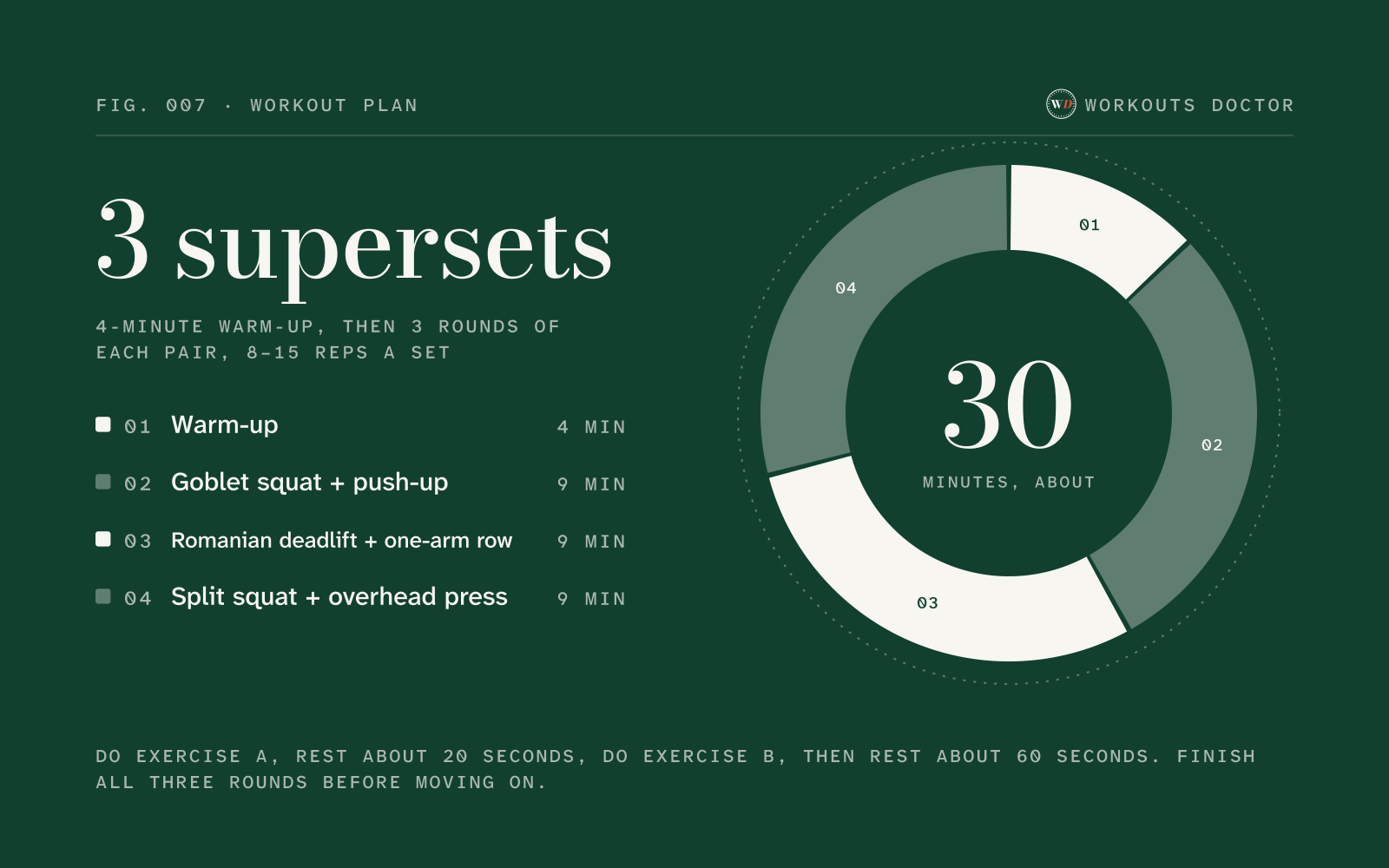
This session trains your whole body with dumbbells in about 30 minutes: a 4-minute warm-up, then three supersets of two exercises, 3 rounds each, 8 to 15 reps per set, ending each set with 1 to 3 reps in reserve. Do it 2 or 3 times a week on non-consecutive days, and progress with reps, tempo and pauses.
A superset means doing two exercises back to back, then resting. Pair exercises that don’t compete, such as a squat and a push-up, and one muscle group recovers while the other works. That’s how a complete session fits into half an hour. The session is our prescription, built from the research below rather than tested as a package.
The 30-minute dumbbell workout: warm-up, supersets and finisher
You need one or two pairs of dumbbells and a sturdy chair. The workout has three parts: a warm-up, the main supersets and an optional finisher.
Warm-up (4 minutes). Go through these once at an easy pace, then do one light set each of goblet squats and push-ups.
| Move | Reps | Notes |
|---|---|---|
| Bodyweight squat | 10 | Sit down and back, chest up |
| Hip hinge | 10 | Hands on hips, push your hips back |
| Incline push-up | 8 | Hands on a table or counter |
| Reverse lunge | 5 each leg | Hold a wall for balance if needed |
| Arm circles | 10 each direction | Small to large |
Main session (about 27 minutes). Do exercise a, rest about 20 seconds, do exercise b, then rest about 60 seconds. Finish all 3 rounds of a superset before moving to the next one.
| Exercise | Sets × reps | Rest after | Notes |
|---|---|---|---|
| 1a. Goblet squat | 3 × 8–15 | 20 s | One dumbbell at your chest, heels down |
| 1b. Push-up | 3 × 6–15 | 60 s | Hands on a bench or counter to make it easier |
| 2a. Dumbbell Romanian deadlift | 3 × 8–15 | 20 s | Hips back, dumbbells close to your legs, back flat |
| 2b. One-arm dumbbell row | 3 × 8–15 each arm | 60 s | Free hand on a chair or sofa |
| 3a. Split squat | 3 × 8–15 each leg | 20 s | Back knee lowers toward the floor |
| 3b. Dumbbell overhead press | 3 × 8–15 | 60 s | Seated or standing; ribs down, no back arch |
Finisher (optional, 3 minutes). Two rounds of dumbbell curls for 10 to 15 reps and a 30- to 45-second plank. It’s a bonus; skip it when time is tight.
Do supersets work as well as regular sets?
On current evidence, yes, and in less time. A 2025 meta-analysis of 19 studies with 313 participants found supersets kept training volume similar to traditional sets while shortening sessions, and long-term gains in strength, muscular endurance and muscle size were similar. A 2021 review of time-efficient training estimated that supersets and similar techniques roughly halve training time while maintaining volume, though they may suit muscle growth better than maximal strength.
Two details matter. In that meta-analysis, pairing two exercises for the same muscle cut the total load lifted, while pairings that alternate upper and lower body, as this session does, showed no significant drop in total reps. And supersets feel harder: perceived exertion and blood lactate were higher, so give yourself a day between sessions. Most participants were young, trained men, so treat the finer details with some caution.
Which version should you do: beginner or harder?
Start with the beginner version if you’re new to lifting or coming back after a long break. Move to the harder version when the beginner one no longer feels like work, even at 15 reps.
| Exercise | Beginner version | Harder version |
|---|---|---|
| Goblet squat | Squat down to a chair | 3-second lowering, 2-second pause at the bottom |
| Push-up | Hands on a counter or bench | Feet on a step, or a 1-second pause near the floor |
| Romanian deadlift | Lighter dumbbells, lower only to just below the knees | Single-leg Romanian deadlift |
| One-arm row | As written | 2-second squeeze at the top |
| Split squat | Hold a wall, no dumbbells | Rear foot on a chair (Bulgarian split squat) |
| Overhead press | Seated | Standing, one arm at a time |
| Rounds and effort | 2 rounds, 2–3 reps in reserve | 3 rounds, 1–2 reps in reserve |
Beginners can move from 2 rounds to 3 after two weeks. The harder version still fits in 30 minutes because it gets harder through the exercises, not through extra rounds.
How heavy should your dumbbells be?
Choose a weight you can lift for the target reps while keeping 1 to 3 reps in reserve (RIR), or 2 to 3 if you’re new. If you get more than 15 clean reps with plenty left, it’s too light for that exercise, so use the harder version. If you can’t reach 8, go lighter or use the beginner version.
Your legs are stronger than your shoulders, so they’ll outgrow a pair of dumbbells first. That’s normal, and it’s why the progressions below lean on single-leg work and tempo.
Light weights are not a compromise for muscle. A 2021 network meta-analysis of 28 studies in 747 healthy adults found muscle growth was similar with light loads (more than 15 reps per set), moderate loads (9 to 15) and heavy loads (8 or fewer), with every set taken to failure, though strength improved more with moderate and heavy loads. A 2021 review of time-efficient training recommends loads you can lift 6 to 15 times, or 15 to 40 reps if you take sets to failure. Our guide to how many reps to do covers the trade-offs.
The catch with high reps is judging effort. A 2022 meta-analysis found people underestimate how many reps they have left by about one on average, and their guesses are less accurate on sets longer than about 12 reps. Every few weeks, take the last set of curls or push-ups until your form starts to break, to recalibrate. Keep Romanian deadlifts and split squats a rep or two short.
How do you progress with fixed dumbbells?
Change one thing at a time, in this order, and move to the next step only when you hit 15 reps on every set at your target effort. Record your reps in a notebook or a workout-tracking app; our guide to choosing a workout app explains what matters.
- Add reps. Work from 8 toward 15. In an 8-week trial of 43 trained lifters doing lower-body exercises, adding reps at the same weight built muscle and strength about as well as adding weight.
- Add a round. Go from 3 rounds to 4 on one superset, which adds about 3 minutes.
- Slow the lowering. Take 3 seconds on the way down, a change of tempo. A 2015 meta-analysis of eight studies found similar muscle growth with reps lasting from half a second to 8 seconds, and suggested reps longer than 10 seconds are worse, so 3 seconds down is plenty.
- Add a pause. Hold 1 to 2 seconds at the hardest point: the bottom of a squat, or just above the floor in a push-up.
- Go single-limb. Bulgarian split squats, single-leg Romanian deadlifts and one-arm presses make each limb handle the whole dumbbell.
- Buy the next pair up. When every exercise is at its hardest version and you still clear 15 reps, it’s time.
How often should you do this workout each week?
Two or three times a week, with at least a day between sessions.
| Schedule | Days | Hard sets per muscle group a week |
|---|---|---|
| 2 days | Monday and Thursday | 6 for most muscle groups, 12 for quads |
| 3 days | Monday, Wednesday and Friday | 9 for most muscle groups, 18 for quads |
Two sessions meet the WHO minimum of muscle-strengthening work on 2 or more days a week. A third session adds weekly sets, and in a 2019 meta-analysis of 25 studies, training more often helped muscle growth mainly by adding volume: when weekly sets were matched, frequency made little difference. On the days in between, walk or do something easy.
Common questions
Can I do this dumbbell workout every day?
Not as written. Each session works every major muscle hard, and supersets raise perceived effort and fatigue more than regular sets, so leave at least a day between sessions. On the days in between, walk, cycle or do some mobility work.
Is 30 minutes enough to build muscle?
Yes, as long as sets end close to failure and you keep progressing. Two or three sessions give each major muscle group 6 to 18 hard sets a week, above the minimum of about 4 weekly sets per muscle that a 2021 review of time-efficient training recommends.
What if I only have one pair of dumbbells?
Use that pair for everything and change the exercise rather than the weight. For legs, switch to single-leg versions, slow the lowering or add pauses; for presses and rows, work up the rep range first. If you're buying one pair, choose a weight you can press overhead 8 to 12 times.
Do I need a bench?
No. Push-ups replace the bench press, a sturdy chair or sofa arm supports your free hand on rows, and a chair works for rear-foot-elevated split squats. A bench adds options such as incline presses, but it isn't required.
Should I add cardio?
Yes, if you can. The WHO recommends 150 to 300 minutes of moderate aerobic activity a week for adults, plus muscle strengthening on 2 or more days. Brisk walking on your non-lifting days is the easiest way to close the gap.
How strong is the evidence?
Evidence: moderateMeta-analyses support supersets for saving time and lighter loads taken close to failure for building muscle, and the WHO backs strength work on 2 or more days a week. Long-term superset trials are few and small, and this session is untested as a package.
Ratings run Strong, Moderate, Emerging and Limited. How we rate evidence.
Sources
- Superset Versus Traditional Resistance Training Prescriptions: A Systematic Review and Meta-analysis Exploring Acute and Chronic Effects on Mechanical, Metabolic, and Perceptual VariablesSports Medicine, 2025
- No Time to Lift? Designing Time-Efficient Training Programs for Strength and Hypertrophy: A Narrative ReviewSports Medicine, 2021
- Resistance Training Load Effects on Muscle Hypertrophy and Strength Gain: Systematic Review and Network Meta-analysisMedicine & Science in Sports & Exercise, 2021
- Effect of repetition duration during resistance training on muscle hypertrophy: a systematic review and meta-analysisSports Medicine, 2015
- Progressive overload without progressing load? The effects of load or repetition progression on muscular adaptationsPeerJ, 2022
- Accuracy in Predicting Repetitions to Task Failure in Resistance Exercise: A Scoping Review and Exploratory Meta-analysisSports Medicine, 2022
- How many times per week should a muscle be trained to maximize muscle hypertrophy? A systematic review and meta-analysis of studies examining the effects of resistance training frequencyJournal of Sports Sciences, 2019
- World Health Organization 2020 guidelines on physical activity and sedentary behaviourBritish Journal of Sports Medicine, 2020
Workouts Doctor publishes general fitness information, not medical advice. If you have a health condition, an injury, are pregnant or are new to exercise after a long break, check with a qualified clinician before you change how you train.