The 3-day full-body workout plan for beginners
Three days a week, two alternating workouts and one rule for adding weight. This is the plan we would hand a friend who is starting out, with the reasoning behind every number.
The short version
- Train full body on three non-consecutive days a week, alternating Workout A and Workout B, for 12 weeks.
- Each session has five exercises, compound lifts first, with 2 to 3 working sets stopped 1 to 3 reps short of failure.
- Use double progression: once every working set reaches the top of the rep range, add the smallest jump available, usually 5 lb (2.5 kg).
- Week 7 is a deload with the same weights and half the sets; take it early if two or more lifts stall at once.
- After 12 weeks, keep running the plan while you are still progressing, or move to a 4-day upper/lower split.
The prescription
No. 012Prescribed forAdults new to lifting, or returning after years off, with access to a gym
- Dose
- 5 exercises per session, 2–3 working sets each, 6–12 reps per set
- Frequency
- 3 non-consecutive days a week, alternating Workout A and Workout B
- Intensity
- Stop each set with 1–3 reps in reserve (3–4 in weeks 1–2)
- Duration
- 12 weeks; about 45–60 minutes per session
- Progression
- Double progression: hit the top of the rep range on every set, then add 5 lb (2.5 kg)
- Caution
- Check with a clinician first if you have heart, blood-pressure or joint problems, or are pregnant
Workouts Doctor · General guidance, not medical advice
Train your whole body on three non-consecutive days a week, alternating Workout A and Workout B, for 12 weeks. Each session is five exercises, compound lifts first, 2 to 3 working sets each, stopped 1 to 3 reps short of failure. When you reach the top of the rep range on every set, add 5 lb (2.5 kg). Week 7 is lighter.
That structure comes straight from the evidence. The American College of Sports Medicine (ACSM) recommends 2 to 3 sessions a week for novices, multi-joint exercises before single-joint ones, and loads you could lift for a maximum of about 8 to 12 reps. Three sessions also make it easy to fit in enough sets: in a 2019 meta-analysis of 25 studies, training a muscle more often helped mainly by adding weekly volume. The exact package is our prescription, built from that research rather than tested as a whole.
What does a 3-day full-body workout schedule look like?
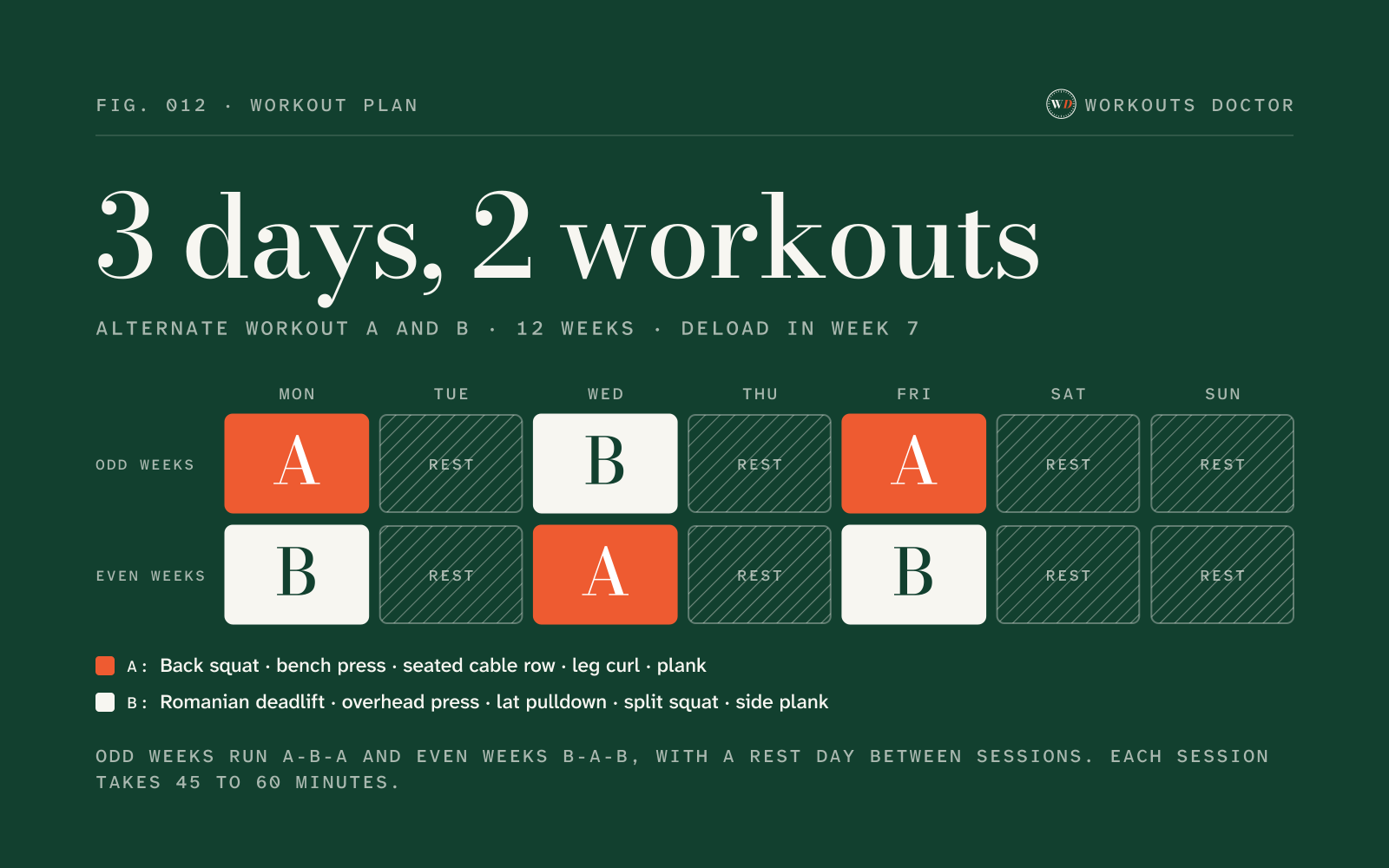
Lift on Monday, Wednesday and Friday, or any three days with a rest day between sessions. Alternate the workouts, so one week runs A-B-A and the next runs B-A-B. Each session takes 45 to 60 minutes with warm-ups.
| Week | Monday | Wednesday | Friday |
|---|---|---|---|
| Odd weeks (1, 3, 5 and so on) | Workout A | Workout B | Workout A |
| Even weeks (2, 4, 6 and so on) | Workout B | Workout A | Workout B |
The 12 weeks run in four phases. Effort is set by reps in reserve (RIR): how many more clean reps you could have done when you stopped. At 2 RIR the last rep slows down, your form holds, and two more were possible.
| Weeks | Working sets | Effort | Goal |
|---|---|---|---|
| 1–2 | 2 per exercise | 3–4 RIR | Learn the lifts, find your weights |
| 3–6 | As written | 2–3 RIR | Add reps, then weight |
| 7 | Half, same weights | 3–4 RIR | Deload and recover |
| 8–12 | As written | 1–2 RIR | Add reps, then weight |
Workout A and Workout B: the full sessions
Do the exercises in the order listed. Compound lifts, which work several joints and big muscle groups at once, come first while you’re fresh.
Workout A
| Exercise | Sets × reps | Rest | Notes |
|---|---|---|---|
| Back squat | 3 × 6–10 | 2–3 min | Use goblet squats until the pattern feels solid |
| Bench press | 3 × 8–12 | 2 min | Barbell or dumbbells; feet planted, shoulder blades pinched |
| Seated cable row | 3 × 8–12 | 90 s–2 min | Pull to your lower ribs without leaning back |
| Leg curl | 2 × 10–15 | 90 s | Machine; lower slowly |
| Plank | 2 × 20–45 s | 60 s | Squeeze your glutes, ribs down |
Workout B
| Exercise | Sets × reps | Rest | Notes |
|---|---|---|---|
| Romanian deadlift | 3 × 6–10 | 2–3 min | Hips back, bar close to your legs, back flat |
| Overhead press | 3 × 8–12 | 2 min | Use dumbbells if the empty bar is too heavy |
| Lat pulldown | 3 × 8–12 | 90 s–2 min | Drive your elbows down toward your back pockets |
| Split squat | 2 × 8–12 each leg | 90 s | Body weight first, then dumbbells; back knee lowers toward the floor |
| Side plank | 2 × 15–30 s each side | 60 s | Bend your knees to make it easier |
Rest long enough to hit your reps on the next set. Short on time? Trim the rests: a 2018 systematic review of 23 studies concluded that 60 to 120 seconds is enough to maximize strength gains in untrained people, while longer rests mattered more for trained lifters. With 10 spare minutes, add 2 sets each of curls and triceps pushdowns. They’re optional.
How do you pick your starting weights?
Start lighter than your ego wants. Weeks 1 and 2 exist to find your numbers, and the plan has plenty of room to catch up.
- Start each lift with the empty bar, usually 45 lb (20 kg), light dumbbells or a light machine setting, and do 10 reps.
- If you could have done five or more extra reps, add a little weight, rest a minute and do another 10.
- Stop when a set of 10 leaves about 3 or 4 reps in the tank. That’s your week 1 weight. The plate calculator tells you what to load on each side.
- Write it down. If week 1 felt easy, add weight in week 2.
In weeks 1 and 2, those ramp-up sets double as your warm-up. After that, warm up before the first lift of each workout: 5 minutes of easy cardio if you’re stiff, then the empty bar for 10 reps, about half your working weight for 5, and about three-quarters for 3. One lighter set of 5 is enough before the second and third lifts. Warm-up sets never count as working sets.
How do you progress? Double progression, step by step
The plan uses double progression: add reps first, then weight.
- Use a weight that gets you into the rep range at your effort target.
- Each session, try to add a rep to any set without breaking form or the effort target.
- When every working set reaches the top of the range, add weight next time: 5 lb (2.5 kg) for upper-body lifts, 5 to 10 lb (2.5 to 5 kg) for squats and Romanian deadlifts, or the next dumbbells up.
- Your reps will drop toward the bottom of the range. Build them back up and repeat.
| Session | Squat weight | Reps per set | Next time |
|---|---|---|---|
| 1 | 95 lb (43 kg) | 8, 8, 7 | Same weight |
| 2 | 95 lb (43 kg) | 9, 9, 8 | Same weight |
| 3 | 95 lb (43 kg) | 10, 10, 10 | Add 5 lb (2.5 kg) |
| 4 | 100 lb (45 kg) | 8, 7, 7 | Build back up |
This mirrors the ACSM rule of adding 2 to 10% to the load once you can beat your target by one or two reps. Adding reps is real progress, too: in an 8-week trial of 43 trained lifters doing lower-body exercises, adding reps at a fixed weight built muscle and strength about as well as adding weight. If a 5-lb jump is too big on presses, use fractional plates or stay at the top of the range for an extra session.
What to do when you stall, and the week 7 deload
A stall means an exercise hasn’t gained a rep or any weight for two weeks. Work through these steps in order.
- Check the basics: sleep, eating enough, and whether you’re actually reaching the effort target.
- Give it one more session. One bad day isn’t a stall.
- Reset: drop the weight by 10% and climb back through the rep range.
- If two or more lifts stall at once, or your joints ache, take the deload now rather than in week 7.
The deload is a planned easier week. Keep the same exercises and weights, halve the sets (rounding up), and stop every set 3 or 4 reps short. In week 8, return to the full plan at your week 6 weights. Why not take the week off entirely? In a 9-week trial of 39 trained lifters, a week without training at the midpoint didn’t change lower-body muscle growth, but strength improved less than in the group that kept training. A lighter week keeps you practicing the lifts.
Exercise swaps for home, dumbbells or sore joints
Swap any exercise for one that trains the same movement, keep the sets and reps, and stick with the swap for all 12 weeks so your numbers stay comparable. If a lift causes sharp pain rather than effort, swap it, and get persistent pain checked.
| Exercise | Gym swap | Home or dumbbell swap |
|---|---|---|
| Back squat | Leg press | Goblet squat |
| Romanian deadlift | Trap-bar deadlift or hip thrust | Dumbbell Romanian deadlift |
| Bench press | Dumbbell or machine chest press | Push-up or dumbbell floor press |
| Seated cable row | Chest-supported or machine row | One-arm dumbbell row |
| Lat pulldown | Assisted pull-up | Band-assisted pull-up, or a second row |
| Overhead press | Machine shoulder press | Seated dumbbell press |
| Leg curl | Back extension | Glute bridge or sliding leg curl |
Training only at home? Our 30-minute dumbbell workout is built for that.
What should you do after 12 weeks?
If you’re still adding reps or weight every week or two, keep going: restart at week 3 with your current weights. A plan that’s working doesn’t need replacing. When progress slows on most lifts, pick one change.
- Add volume. Do a fourth set on the first two exercises of each workout.
- Change variations. Swap in a front squat, trap-bar deadlift, incline press or a different row, and restart the rep ranges.
- Move to four days. The ACSM suggests 3 to 4 sessions a week once you have about six months of consistent training. Our 4-day upper/lower split is the natural next step.
Common questions
Can I do this plan at home with only dumbbells?
Yes. Use the home swaps in the substitution table: goblet squats, dumbbell Romanian deadlifts, push-ups or floor presses, one-arm rows and dumbbell presses. Your legs will outgrow light dumbbells first, so switch to single-leg versions or slow the lowering before you buy heavier ones.
Should I do cardio on my rest days?
Yes, if you can. The WHO recommends 150 to 300 minutes of moderate aerobic activity a week for adults, on top of muscle strengthening on 2 or more days. Brisk walking or easy cycling on your rest days is a simple way to get there.
What if I miss a workout?
Do the next workout in the sequence at your next session and carry on. Don't cram two workouts into one day to catch up. If you miss a week or more, repeat your last weights for one session before you start adding again.
Will this plan build muscle, or just strength?
Both. A 2023 network meta-analysis of randomized trials found every resistance training prescription it examined improved strength and muscle size compared with not training. Heavier loads gave the most strength, muscle growth was similar across prescriptions, and multiple sets ranked highest for growth.
Is this plan suitable for women and older adults?
Yes. The principles are the same; only the starting weights differ. Women made up 45% of participants in the strength trials of that 2023 meta-analysis. Older adults should start at the light end of each range, and anyone with a medical condition should check with a clinician first.
How strong is the evidence?
Evidence: strongA network meta-analysis of more than 170 randomized trials found every common lifting prescription builds strength and muscle, and the ACSM backs 2 to 3 days a week for novices. This exact plan is our prescription, not a tested package.
Ratings run Strong, Moderate, Emerging and Limited. How we rate evidence.
Sources
- American College of Sports Medicine position stand. Progression models in resistance training for healthy adultsMedicine & Science in Sports & Exercise, 2009
- Resistance training prescription for muscle strength and hypertrophy in healthy adults: a systematic review and Bayesian network meta-analysisBritish Journal of Sports Medicine, 2023
- How many times per week should a muscle be trained to maximize muscle hypertrophy? A systematic review and meta-analysis of studies examining the effects of resistance training frequencyJournal of Sports Sciences, 2019
- Effect of Resistance Training Frequency on Gains in Muscular Strength: A Systematic Review and Meta-AnalysisSports Medicine, 2018
- Progressive overload without progressing load? The effects of load or repetition progression on muscular adaptationsPeerJ, 2022
- Effects of Rest Interval Duration in Resistance Training on Measures of Muscular Strength: A Systematic ReviewSports Medicine, 2018
- Gaining more from doing less? The effects of a one-week deload period during supervised resistance training on muscular adaptationsPeerJ, 2024
- World Health Organization 2020 guidelines on physical activity and sedentary behaviourBritish Journal of Sports Medicine, 2020
Workouts Doctor publishes general fitness information, not medical advice. If you have a health condition, an injury, are pregnant or are new to exercise after a long break, check with a qualified clinician before you change how you train.