The 4-day upper/lower split for intermediate lifters
Once you stop adding weight every week, you need more volume, smarter effort and a plan for fatigue. A 4-day upper/lower split handles all three without living in the gym.
The short version
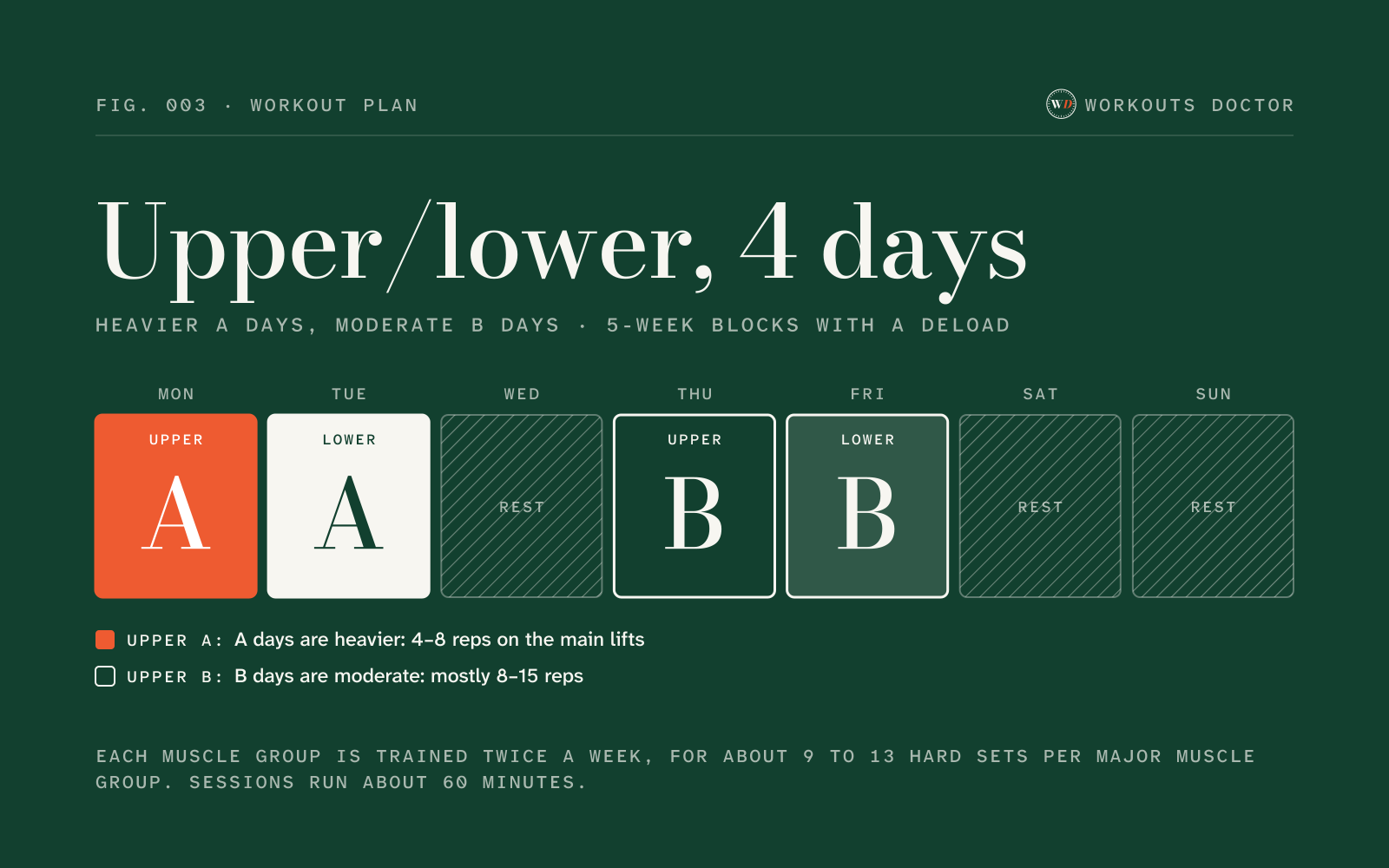
- Train upper body twice and lower body twice a week: one heavier day with 4 to 8 reps on the main lifts and one moderate day with mostly 8 to 15 reps.
- The plan gives 9 to 13 weekly sets per major muscle group, counting indirect work as half sets; add 2 to 4 weekly sets for a muscle only when it stalls and you recover well.
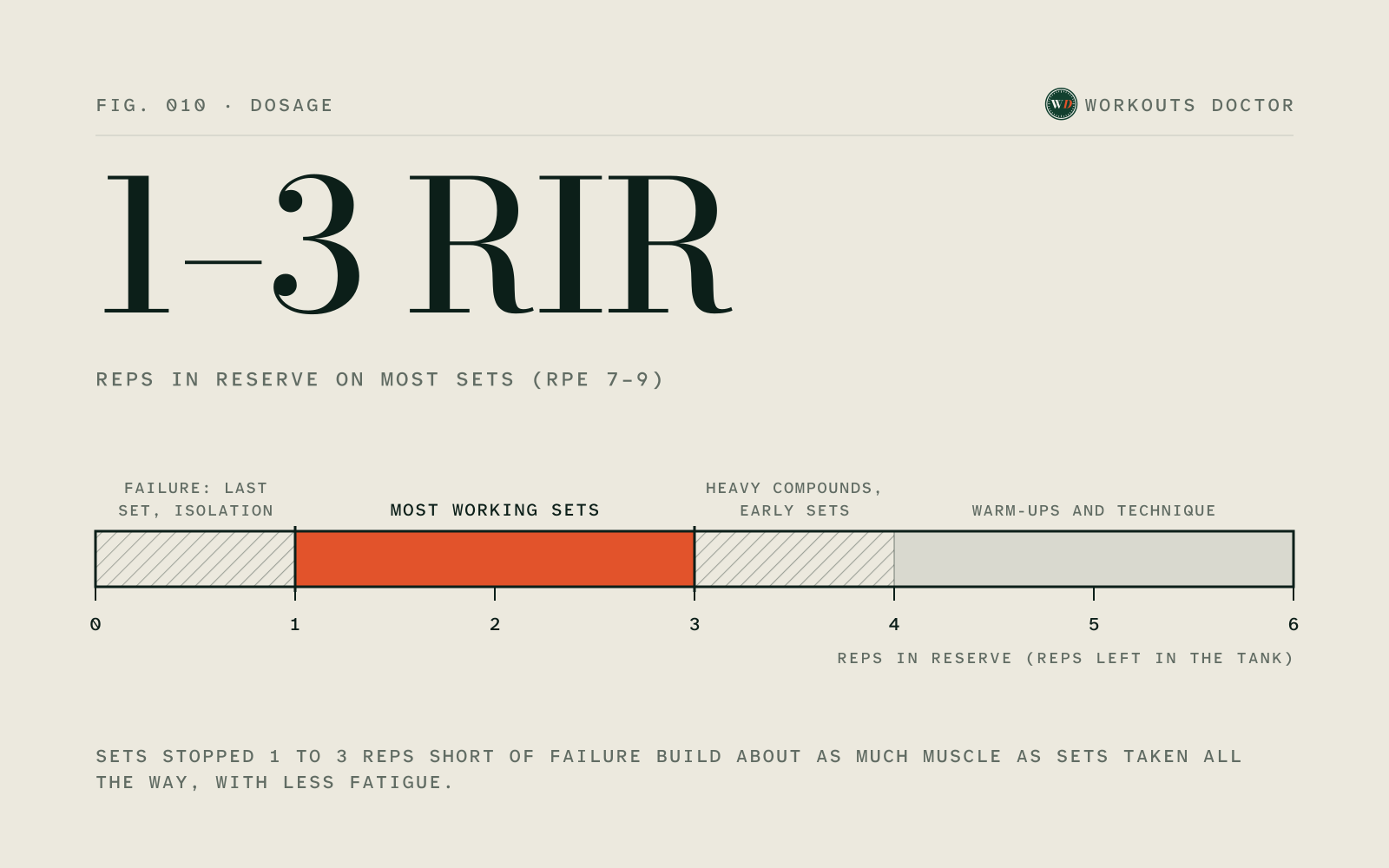
- Set effort with reps in reserve: compound lifts move from 3 to 1 or 2 reps in reserve across a block, and isolation exercises can go to 0 or 1.
- Train hard for 4 weeks, then deload in week 5 with the same exercises, about half the sets and 3 to 4 reps in reserve.
- On three days a week, rotate the four sessions in order and add a set to the first exercise of each session.
The prescription
No. 003Prescribed forLifters with 6+ months of consistent training who can lift 4 days a week
- Dose
- 15–19 working sets per session; 9–13 sets per major muscle group a week
- Frequency
- 4 days a week: Upper A, Lower A, rest, Upper B, Lower B
- Intensity
- Compound lifts 1–3 reps in reserve; isolation exercises 0–2
- Duration
- 5-week blocks (4 build weeks, 1 deload); about 60 minutes per session
- Progression
- Add load when every set reaches the top of the rep range at the week's RIR target
- Caution
- Never grind squats or barbell presses to failure without safety bars or a spotter
Workouts Doctor · General guidance, not medical advice
Train four days a week: Upper A and Lower A early in the week, Upper B and Lower B later. The A days are heavier, with 4 to 8 reps on the main lifts; the B days are moderate, with mostly 8 to 15. That gives 9 to 13 sets per major muscle each week, with effort set by reps in reserve and a deload every fifth week.
The plan is for you if you’ve trained consistently for at least six months, your main lifts no longer go up every week, and you can lift four days a week for about an hour. Newer than that? The 3-day full-body plan is simpler and will keep working.
The split isn’t magic, just a practical way to fit enough weekly sets into sessions you can recover from. The package is our prescription, built from the research below rather than tested as a whole.
What does the 4-day upper/lower schedule look like?
Lift Monday, Tuesday, Thursday and Friday, or any four days that keep the two lower-body sessions apart.
| Day | Session | Focus |
|---|---|---|
| Monday | Upper A | Heavier: 4–8 reps on main lifts |
| Tuesday | Lower A | Heavier: 4–8 reps on main lifts |
| Wednesday | Rest | Walk or do easy cardio |
| Thursday | Upper B | Moderate: mostly 8–15 reps |
| Friday | Lower B | Moderate: mostly 8–15 reps |
| Weekend | Rest | Optional easy cardio |
Run the plan in 5-week blocks, with effort set by reps in reserve (RIR): how many clean reps you could still have done when you stopped. Isolation exercises are the curls, raises, extensions, leg curls and calf raises; everything else is a compound lift.
| Week | Compound lifts | Isolation exercises | Sets |
|---|---|---|---|
| 1 | 3 RIR | 2 RIR | As written |
| 2 | 2–3 RIR | 1–2 RIR | As written |
| 3 | 2 RIR | 1 RIR | As written |
| 4 | 1–2 RIR | 0–1 RIR | As written |
| 5 (deload) | 3–4 RIR | 3–4 RIR | About half |
Upper A and Lower A: the heavier days
Heavier days build strength with lower reps and longer rests. Take the full 3 minutes on the first exercise.
Upper A (heavier)
| Exercise | Sets × reps | Rest | Notes |
|---|---|---|---|
| Bench press | 4 × 4–6 | 3 min | Feet planted, bar to mid-chest, safeties set |
| Chest-supported row | 4 × 6–8 | 2–3 min | Or a barbell row with a flat back |
| Seated dumbbell shoulder press | 3 × 6–10 | 2 min | Back against the bench, ribs down |
| Pull-up | 3 × 6–10 | 2 min | Add weight above 10 reps; use a pulldown below 6 |
| EZ-bar curl + overhead triceps extension | 2 × 8–12 each | 90 s | Superset: alternate the two |
Lower A (heavier)
| Exercise | Sets × reps | Rest | Notes |
|---|---|---|---|
| Back squat | 4 × 4–6 | 3 min | In a rack with safety bars set |
| Romanian deadlift | 3 × 6–8 | 2–3 min | Hips back, bar close, back flat |
| Bulgarian split squat | 2 × 8–10 each leg | 2 min | Rear foot on a bench |
| Lying leg curl | 3 × 8–12 | 90 s | Control the lowering |
| Standing calf raise | 3 × 6–10 | 90 s | Pause 1 second at the bottom |
Upper B and Lower B: the moderate days
The moderate days add volume with lighter loads, more reps and shorter rests.
Upper B (moderate)
| Exercise | Sets × reps | Rest | Notes |
|---|---|---|---|
| Incline dumbbell press | 3 × 8–12 | 2 min | Bench at about 30 degrees |
| Lat pulldown | 3 × 10–12 | 2 min | Neutral or shoulder-width grip |
| Machine chest press | 3 × 10–15 | 90 s | Or push-ups |
| Seated cable row | 3 × 10–15 | 90 s | Pause at your ribs |
| Dumbbell lateral raise | 3 × 12–20 | 60 s | Lead with the elbows, no swinging |
| Cable curl + triceps pushdown | 2 × 10–15 each | 60 s | Superset: alternate the two |
Lower B (moderate)
| Exercise | Sets × reps | Rest | Notes |
|---|---|---|---|
| Leg press | 3 × 10–15 | 2 min | Stop lowering before your hips curl up |
| Hip thrust | 3 × 8–12 | 2 min | Pause 1 second at the top, chin tucked |
| Seated leg curl | 3 × 10–15 | 90 s | Full stretch on every rep |
| Leg extension | 3 × 12–15 | 60–90 s | Squeeze at the top |
| Seated calf raise | 3 × 12–20 | 60 s | Full range, no bouncing |
Swap freely within a movement and rep range, but keep swaps for the whole block: a machine press for the bench press, a Smith machine squat for the back squat, a back extension for the Romanian deadlift.
How many sets per muscle does this split give you?
Chest, back and the big leg muscles get 9 to 13 direct sets; shoulders and arms get fewer, plus indirect work from presses and pulls.
| Muscle group | Main exercises | Direct sets a week |
|---|---|---|
| Chest | Bench, incline and machine press | 10 |
| Back | Rows, pull-ups, pulldowns | 13 |
| Shoulders | Shoulder press, lateral raise | 6, plus 10 sets of chest pressing |
| Biceps and triceps | Curls, extensions, pushdowns | 4 each, plus 13 pulling or pressing sets |
| Quads | Squat, split squat, leg press, leg extension | 12 |
| Hamstrings | Romanian deadlift, two leg curls | 9 |
| Glutes | Squat, Romanian deadlift, split squat, hip thrust | 12 |
| Calves | Two calf raises | 6 |
A 2026 meta-regression of 67 studies with 2,058 participants, mostly young men, found muscle and strength gains rise with weekly sets, with diminishing returns that are more pronounced for strength than for size. It also found that counting indirect sets, like triceps work during presses, as half sets predicted results best, which puts arms and shoulders at about 10 to 11 sets a week.
An earlier 2017 meta-analysis of 15 studies found the same graded dose-response for muscle growth. Our guide to how many sets per week explains the range, and the weekly sets calculator checks your numbers.
How do you progress with reps in reserve?
Pick loads that hit the rep target at the week’s RIR, and let your log decide when to add weight. A 2016 study of 29 squatters found RIR ratings tracked bar speed closely and called the scale a practical way to regulate daily training loads.
- Compound lifts. When every set reaches the top of the rep range at or above the week’s RIR target, add weight next week: 5 lb (2.5 kg) on upper-body lifts, 5 to 10 lb (2.5 to 5 kg) on lower-body lifts. Otherwise keep the weight and add reps.
- Isolation exercises. Add reps until every set hits the top of the range, then add the smallest increment.
- Adjust on the day. If your first working set is 2 or more reps harder than planned, take 5 to 10% off the rest; if it’s 2 or more reps easier, add 5 to 10 lb (2.5 to 5 kg).
Expect your estimates to run conservative. A 2022 meta-analysis of 12 studies with 414 people found they underestimated their reps left by about one, with better accuracy closer to failure and on sets of 12 reps or fewer. Your 2 RIR is probably nearer 3.
Failure itself is optional. A 2023 meta-analysis of 15 studies found no evidence that training to momentary failure builds more muscle than stopping short, while a 2024 exploratory meta-regression found growth increased as sets ended closer to failure, with strength gains similar across a wide range of RIR. Hence 1 to 3 RIR on heavy compound lifts, and 0 to 2 on isolation work, where a missed rep is harmless. More in our guide to training to failure.
When to deload, and what to do when you stall
Deload in week 5 of every block, or sooner if fatigue piles up. Keep the same exercises, cut the sets roughly in half, keep the weights the same or about 10% lighter, and stop every set 3 to 4 reps short.
In a 2023 consensus study, an international panel of strength and physique coaches agreed a deload can mean fewer sets, reps or sessions, or stopping further from failure. Deloading every 4 to 6 weeks is common, but the authors note limited evidence that pre-planned deloads beat a flexible approach, and the panel agreed you can deload whenever you feel physically and mentally fatigued.
If a compound lift stalls for two straight weeks at the planned RIR:
- Check sleep, food and stress first.
- Drop the load about 10% and build back up over two weeks.
- Next block, rotate to a close variation, such as a paused squat or incline bench press.
- If several lifts stall at once and you feel beaten up, deload now.
If you recover well but a muscle hasn’t grown in a block or two, add 2 to 4 weekly sets for it next block; small steps show what actually helps.
How to run the upper/lower split on 3 days
Rotate the four sessions in order across three training days, so each comes around every nine or ten days. Each muscle is trained about 1.5 times a week instead of twice and weekly sets drop by a quarter, so add a set to the first exercise of each session.
| Week | Monday | Wednesday | Friday |
|---|---|---|---|
| 1 | Upper A | Lower A | Upper B |
| 2 | Lower B | Upper A | Lower A |
| 3 | Upper B | Lower B | Upper A |
| 4 | Lower A | Upper B | Lower B |
For muscle growth, that matters little if weekly sets hold steady: a 2019 meta-analysis of 25 studies found frequency made little difference once volume was matched. Strength is different; the 2026 meta-regression found strength gains rise with frequency, so expect main lifts to progress a little more slowly.
Common questions
How long should each session take?
About 60 minutes with warm-ups, a little longer on the heavier days because of the 3-minute rests. The arm work is already written as supersets to save time. If you still run long, cut the last exercise to 2 sets rather than shortening rests on the main lifts.
How do I know I'm ready for an upper/lower split?
You're ready if you've trained consistently for about six months and your main lifts no longer go up every week or two on a beginner plan. If you're still adding weight most sessions, a simpler 3-day full-body plan will keep working.
Can I add extra work for a lagging muscle?
Yes. Add 2 sets of one exercise for that muscle on each of its two days, and keep the rest of the plan the same so you can tell whether it helped. If sessions run long or recovery suffers, take sets from a muscle that's already growing well.
Should the last set of an exercise go to failure?
Not on squats, deadlifts or barbell presses, where a failed rep is risky and adds a lot of fatigue. On curls, lateral raises and leg curls, an occasional set to failure is low risk and helps you check your reps-in-reserve estimates.
Can I run this split with only dumbbells?
Yes, with swaps: dumbbell bench and incline presses, one-arm rows, goblet and Bulgarian split squats, and dumbbell Romanian deadlifts. A doorway pull-up bar covers vertical pulling. Your legs will outgrow light dumbbells first, so lean on single-leg exercises and slower lowering.
How strong is the evidence?
Evidence: moderateMeta-analyses consistently link more weekly sets to more muscle and strength, and more frequent training to more strength, but most participants were young men and no trial has tested this exact split.
Ratings run Strong, Moderate, Emerging and Limited. How we rate evidence.
Sources
- The Resistance Training Dose Response: Meta-Regressions Exploring the Effects of Weekly Volume and Frequency on Muscle Hypertrophy and Strength GainsSports Medicine, 2026
- Dose-response relationship between weekly resistance training volume and increases in muscle mass: A systematic review and meta-analysisJournal of Sports Sciences, 2017
- How many times per week should a muscle be trained to maximize muscle hypertrophy? A systematic review and meta-analysis of studies examining the effects of resistance training frequencyJournal of Sports Sciences, 2019
- Exploring the Dose-Response Relationship Between Estimated Resistance Training Proximity to Failure, Strength Gain, and Muscle Hypertrophy: A Series of Meta-RegressionsSports Medicine, 2024
- Influence of Resistance Training Proximity-to-Failure on Skeletal Muscle Hypertrophy: A Systematic Review with Meta-analysisSports Medicine, 2023
- Accuracy in Predicting Repetitions to Task Failure in Resistance Exercise: A Scoping Review and Exploratory Meta-analysisSports Medicine, 2022
- Novel Resistance Training-Specific Rating of Perceived Exertion Scale Measuring Repetitions in ReserveJournal of Strength and Conditioning Research, 2016
- Integrating Deloading into Strength and Physique Sports Training Programmes: An International Delphi Consensus ApproachSports Medicine - Open, 2023
Workouts Doctor publishes general fitness information, not medical advice. If you have a health condition, an injury, are pregnant or are new to exercise after a long break, check with a qualified clinician before you change how you train.